
Qatar’s emir urges diplomacy as Gulf at ‘one of the most dangerous phases’
 22 September 2026
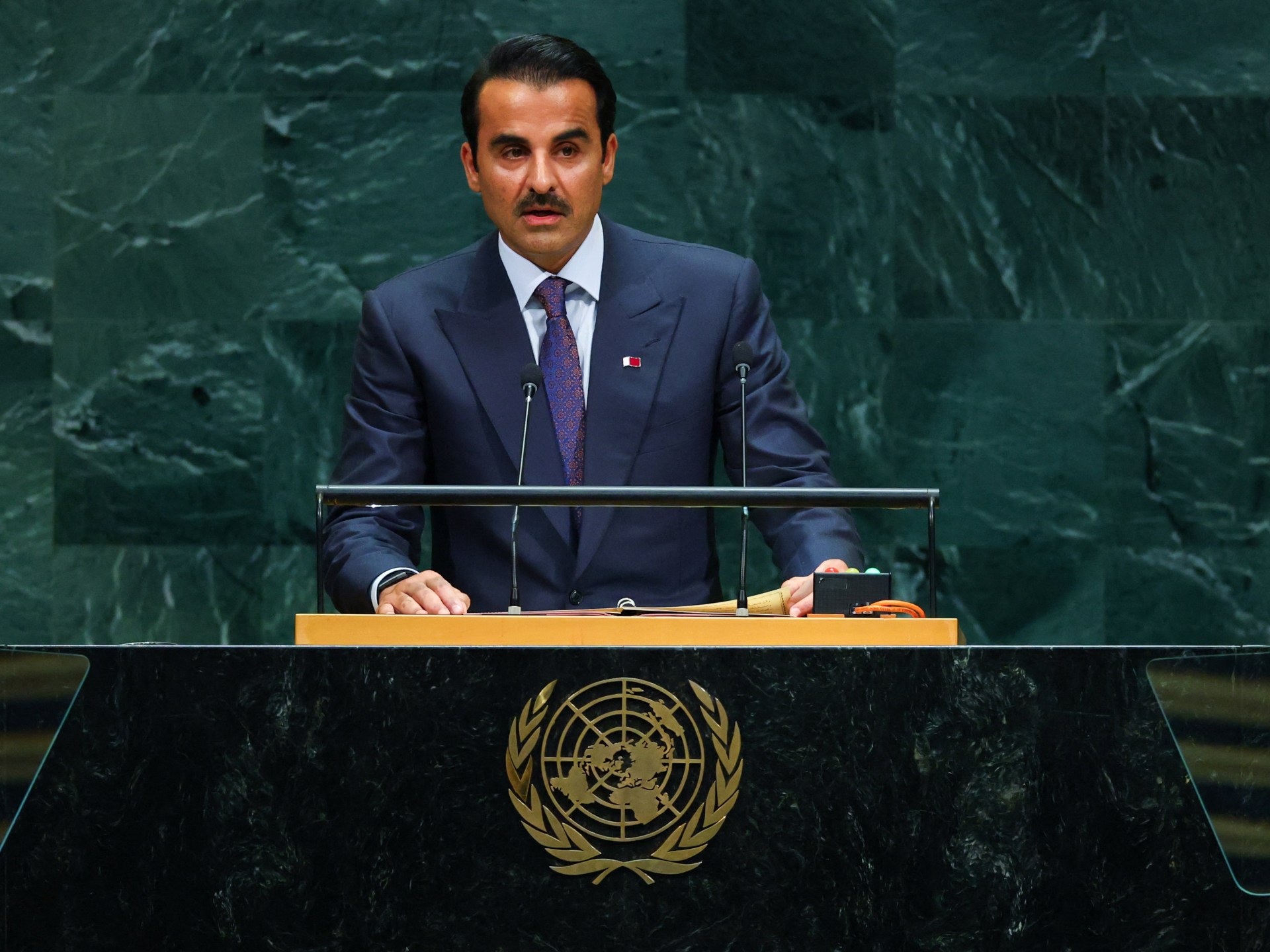

The Gulf is experiencing “one of the most dangerous phases” due to the US-Israeli war on Iran that “can be resolved through diplomatic means”, Qatar’s Emir Sheikh Tamim bin Hamad Al Thani has said at the United Nations General Assembly.
Reaffirming Qatar’s role as a “trusted mediator”, Sheikh Tamim said on Tuesday that diplomacy would lead to a lasting solution ensuring security for the entire region, including Iran.
- list 1 of 4UNGA 2026: Can the UN stop wars?
- list 2 of 4‘War crime’: Jordan’s king slams Israeli West Bank expansion
- list 3 of 4Erdogan slams Israel’s ‘genocidal mindset’ in blistering UN address
- list 4 of 4Lula warns against foreign interference, defends Brazil’s sovereignty at UN
end of list
“We remain convinced that the crisis in the Gulf can be resolved through diplomatic means, through reopening the Strait of Hormuz to maritime navigation, in order to avert war,” Sheikh Tamim said, in translated remarks.
Qatar is doing “everything in our power to address the conflict in the region through diplomatic means” but remains “steadfast” in defending its territory and sovereignty, he said.
Sheikh Tamim said the war on Iran was the “cumulative result of years” of postponing diplomatic resolutions and called for a “regional system of collective security”.
“In the absence of such a system, it has become possible for a war to erupt,” he said.

Sheikh Tamim slammed Israel for its “aggression” in the occupied West Bank and Gaza, saying attacks have expanded to neighbouring countries, “affecting the security of the region as a whole”.
“There can be no talk of a just international order as long as Palestine remains in its plight,” he said. “What has transpired in Gaza is genocide in every sense of the word.”
Advertisement
Sheikh Tamim expressed Qatar’s support for Lebanon, Sudan and Libya, calling for state sovereignty.
“We support United Nations efforts aimed at reaching a comprehensive political settlement based on the outcomes of the national dialogue facilitated by the United Nations, in a manner that preserves Yemen’s unity and sovereignty and achieves security and stability,” he said.
Related News
‘Not welcome’: How Sweden’s far right took over Stockholm Central Station

20 million children a year face online sexual abuse, UNICEF says
Burnham, Macron talk border security and stronger Europe-UK ties