

Kyiv, Ukraine – It was, perhaps, Ukraine’s quietest victory over Russia’s oldest and closest ally.
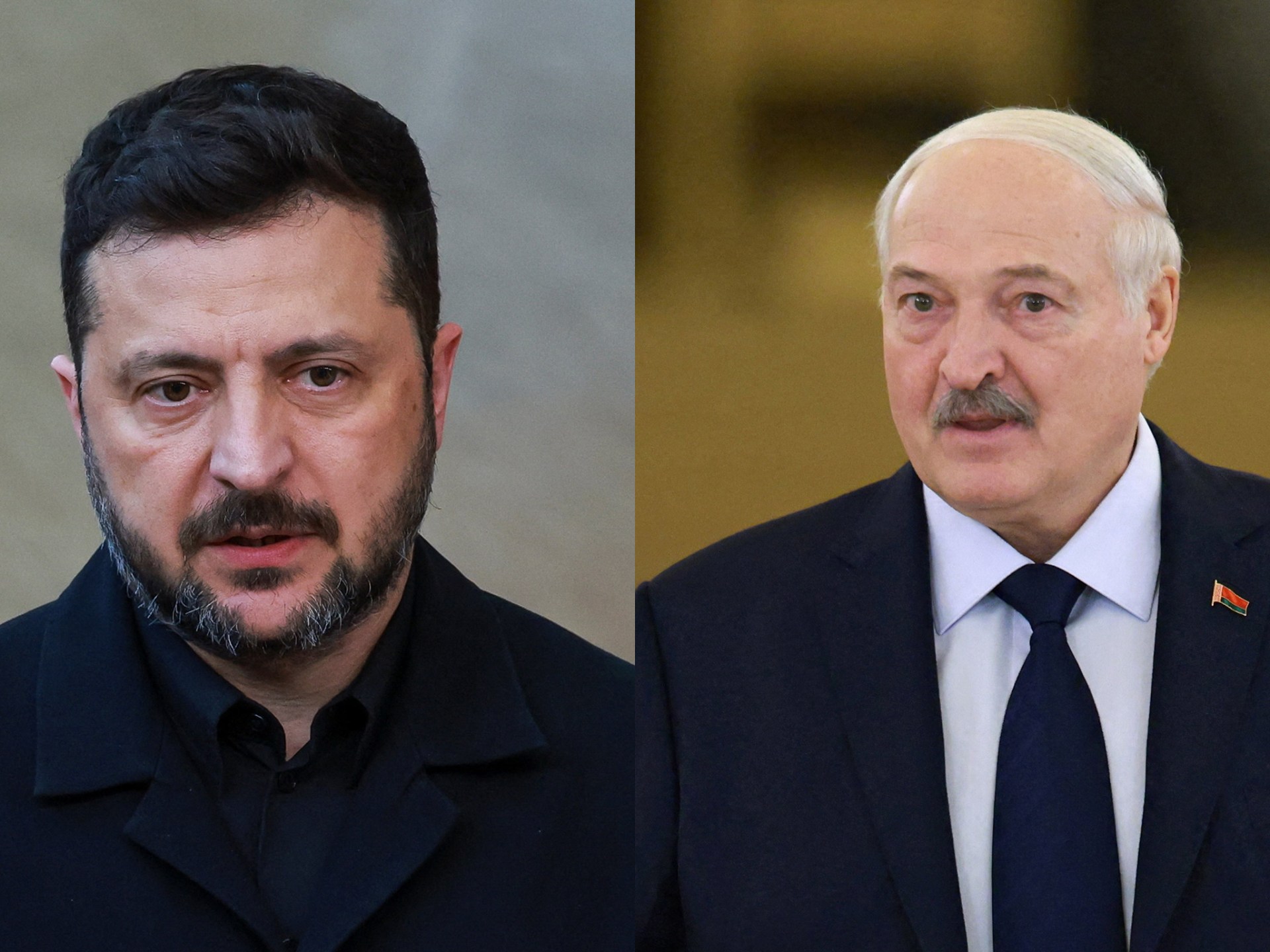
Ukrainian President Volodymyr Zelenskyy urged neighbouring Belarus to shut down four Moscow-installed relay stations that help guide Russian drone attacks on Ukraine.
- list 1 of 4Russia reports downing 660 Ukrainian drones, denies seeking Belarus war aid
- list 2 of 4Three killed as Ukraine and Russia trade attacks overnight
- list 3 of 4Why is Crimea critical to the Russia–Ukraine war?
- list 4 of 4Ukraine says it attacked two Russian oil refineries
end of list
The border between Ukraine and Belarus stretches for 1,084km (674 miles), mostly across swamps and Europe’s largest and densest forests.
The stations – originally cellular communication towers – relay signals for Russian drone operators and allow their unmanned aircraft to exchange information with each other and fly deep into western Ukraine, which has few drone interceptors and NATO-supplied air defence systems.
The relayers did “make the signal stronger” and the Russian attacks “more precise”, Andriy Pronin, one of the pioneers of drone warfare in Ukraine, told Al Jazeera.
Zelenskyy said on June 19 that Belarusian President Aleksander Lukashenko allowed Russia to run “equipment that corrects fire on Ukrainian civilians, specifically civilians”.
And then he issued an ultimatum that reflects Kyiv’s newfound assertiveness.
“I think one week will be enough” for Lukashenko to remove the relayers, Zelenskyy said. “If he doesn’t do that, we will.”
‘A barking dog doesn’t bite’
With its heavy bomber drones and missiles, Kyiv is capable of striking Belarus, a country about a third of the size of Ukraine whose air defence systems are too obsolete to effectively repel drone attacks.
The commander of Ukraine’s drone forces was far less diplomatic than Zelenskyy.
Advertisement
“A barking dog doesn’t bite,” Robert Browdy wrote on Facebook, referring to Lukashenko. “The first 500 targets [in Belarus] have been marked. A free and very practical advice – get out of Ukraine’s sight.”
Lukashenko, an ex-collective farm manager who became one of the world’s longest-ruling leaders and has helmed his nation of 10 million people since 1994, hinted that he may retaliate by targeting the Chornobyl Nuclear Power Plant.
The site of the world’s largest nuclear disaster sits in a forested, cordoned-off exclusion zone next to the Belarusian border – and less than 100km (62 miles) north of Kyiv.
“We have one goal, a serious one, with exact coordinates and not far from Belarus at all,” Lukashenko said in televised remarks.
But by Thursday, he quietly had shut down the relayers, Zelenskyy said.
“Whether they were dismantled or not, I honestly don’t know,” the Ukrainian president said during a news conference. “But we’re working on it. The fact is that the relayers don’t work for now.”
The last Russian drone crossed the Belarusian-Ukrainian border on Sunday, Flagstock, an independent Belarusian publication, reported, quoting residents of border regions.
Lukashenko explained the shutdown as a peacemaking step – and tried to assure the Kremlin that he is always on its side.
“I told [Ukrainian negotiators] directly, ‘Boys, you go tell your president that if he thinks he can talk to us this way and force us into the war, then he has to understand that the quality of the war will change momentarily. It will be an absolutely different war,” Lukashenko was quoted by his country’s state-run news agency, Belta, as saying.
“Our position is about peace. But in any situation, we will be next to Russia,” he said.
According to a Belarus-born, Kyiv-based analyst, Zelenskyy’s ultimatum worked.
“Ukraine deliberately ups its ante in its dialogue with Belarus,” Ihar Tyshkevich told Al Jazeera.
Apart from removing the immediate threat from drone attacks, it may herald a separate track in Ukraine’s negotiations with Belarus.
The talks may help Lukashenko “exit” Belarus’s diplomatic and economic isolation by the West and “balance Russia’s influence”, Tyshkevich said.
Lukashenko is one of the members of United States President Donald Trump’s Board of Peace, which may play a role in rebuilding post-war Ukraine.
But Kyiv would have its own list of demands before allowing Belarusian companies to take part in the restoration and letting Belarusian goods such as petrol, foodstuffs and construction materials back in.
Advertisement
“For Ukraine, it’s a matter of Lukashenko’s responsibility for the war and the defence of Ukraine’s interests,” Tyshkevich said.
The shutdown is Lukashenko’s “attempt to find an indirect compromise” with Kyiv, according to Volodymyr Fesenko, head of the Kyiv-based Penta think tank.
“This is a concession to Zelenskyy’s ultimatum but not a public one, not an official one,” he told Al Jazeera.

Moscow could be disappointed by Lukashenko caving in, but it has so far not commented on it.
Russia “undoubtedly saw it as a manifestation of Lukashenko’s weakness”, Fesenko said.
However, Russia “is not ready to help him, including because it lacks military resources”, he said.
On Tuesday, Kremlin spokesman Dmitry Peskov called Zelenskyy’s ultimatum “absolutely aggressive” and added that Russian President Vladimir Putin would “soon” discuss it with Lukashenko.
A day later, Lukashenko travelled to Moscow to meet with Putin. The Kremlin did not hold a news conference and did not release any information about their meeting.
Moscow has been urging Belarus to take part in the war since its beginning, but Lukashenko repeatedly refused while managing to demand more political and economic concessions from Russia.
In late May, he and Putin presided over joint military drills that “rehearsed” the use of Russia’s nuclear weapons.
As part of the drills, Moscow supplied Minsk with modified Su-25 fighter jets, Iskander-M ballistic missiles and nuclear weapons that are reportedly stored less than 200km (124 miles) north of the Ukrainian border.
A Belarusian shift as Russia’s front-line woes grow
Lukashenko’s change of tone heralds Kyiv’s success in slowing down Moscow’s offensive and destroying oil terminals, refineries, fuel depots and supply routes in Russia and Russia-occupied Ukrainian regions.
“What’s significant is that now Ukraine acts from the position of power and Lukashenko has to reckon with it,” Fesenko said.
Ukrainian drones, for instance, could within hours kill his golden goose – the Mozyr and Novopolotsk oil refineries.
Built in the Soviet Union’s waning days, they process discounted Russian crude – and Lukashenko sells the production in Eastern Europe and Russia.
The fuel supplies have become vital for Moscow in recent weeks as every Russian region experiences petrol shortages after Ukrainian drone attacks.
Eastern European nations have long been tired of Lukashenko’s political escapades.
In 2021, he allowed thousands of refugees and migrants, mostly from the Middle East and North Africa, to arrive in Belarus and cross into Poland and Lithuania in a move that was widely seen as a response to Western sanctions.
The European Union’s executive arm, the European Commission, said on June 22 that Zelenskyy’s ultimatum affirms “Ukraine’s right to self-defence.”