

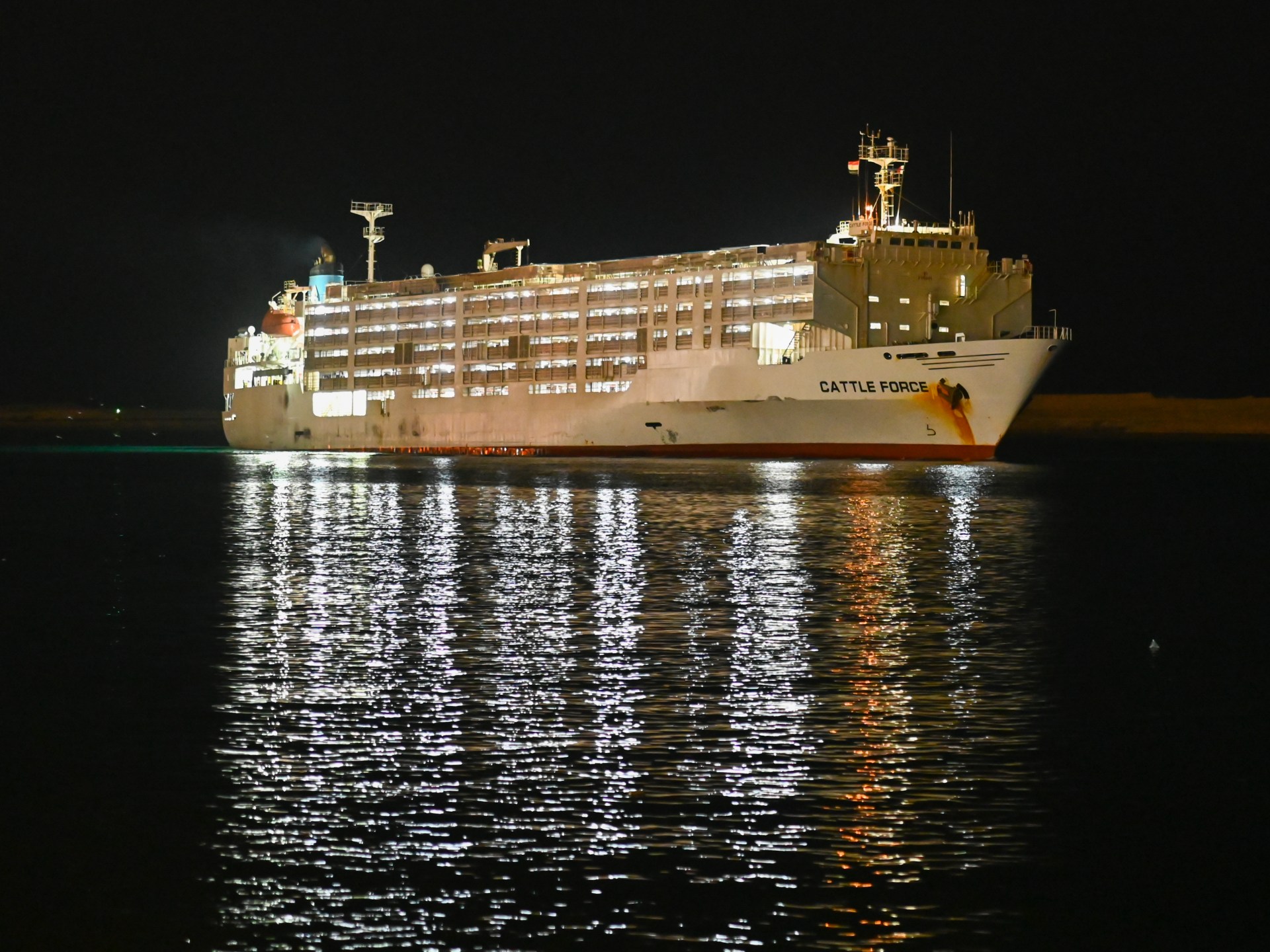

Two tankers carrying Saudi crude to Asia have reversed course in the Red Sea after Yemen’s Houthis announced a blockade of Saudi ports, raising fears that disruptions to another of the world’s most important shipping routes could further restrict global oil supplies.
The vessels, the Rodos and Xin Long Yang, were carrying a combined 2.8 million barrels of oil from Saudi Arabia’s western port of Yanbu when they turned north after initially sailing towards Bab al-Mandeb, the strait that separates Yemen from the Horn of Africa, according to the shipping analytics firm Kpler.
- list 1 of 4Al Jazeera reports from anti-US protest outside ASEAN summit
- list 2 of 4Ossoff challenges Hegseth on cost and duration of Iran war
- list 3 of 4America’s decades-old bipartisan consensus on Israel has been shattered
- list 4 of 4Ukraine hits more warehouses of top Russian online retailer
end of list
Their movements are the first visible sign that the Houthi threat is beginning to affect Saudi oil exports. They also expose a growing weakness in Riyadh’s efforts to protect its energy trade from the United States-Israel war on Iran.
Saudi Arabia had been able to partially bypass disruptions in the Strait of Hormuz by transporting crude through pipelines to Yanbu on the Red Sea. But with shipping through Bab al-Mandeb now also under threat, the alternative corridor that helped reduce the kingdom’s dependence on Hormuz faces its own security risks.
Asian refiners are now considering an exceptionally long diversion: sending oil northwest from Yanbu, through Egypt’s Suez Canal and into the Mediterranean before sailing around Africa and the Cape of Good Hope and on to Asia.
The route could keep some Saudi crude moving if Bab al-Mandeb becomes impassable. But it would add weeks to delivery times, substantially increase freight and fuel costs, and create logistical problems that could limit how much oil Saudi Arabia is able to export.
Advertisement
So can the Suez Canal offer a route that can carry oil quickly and affordably enough to prevent a deeper supply shock for Asian consumers while preventing oil prices from spiking to above $100 a barrel? Here’s what we know:
Two crucial waterways under pressure
The threat in the Red Sea comes as shipping through the Strait of Hormuz is already severely disrupted by the conflict between Washington and Tehran.
Before the war, about one-fifth of the world’s oil and liquefied natural gas supplies passed through the narrow waterway, which connects Gulf producers with international markets. But traffic has fallen sharply as Iran restricts passage through the strait and the US blocks vessels travelling to and from Iranian ports and coastal areas.
Only three commodity vessels were recorded sailing through the Strait of Hormuz on Tuesday, down from four a day earlier, according to Kpler data. No very large crude carriers or liquefied natural gas tankers were sighted passing through the strait, leaving Gulf exporters with sharply different levels of exposure.
Iraq, Qatar, Kuwait and Bahrain depend almost entirely on Hormuz to export their oil or liquefied natural gas. Saudi Arabia and the United Arab Emirates are also heavily reliant on the waterway but have pipelines connecting production centres to alternative terminals on the Red Sea and the Gulf of Oman.
During the Strait of Hormuz’s essential closure for most of the past five months, Saudi Arabia redirected growing volumes of crude through Yanbu. The port exported about 4.1 million barrels per day in June, rerouting roughly 64 percent of the Saudi oil that would otherwise have left through Hormuz, according to Kpler.
But that workaround is now in doubt as the Houthis announced a naval blockade of Saudi Arabia on Monday, days after threatening to impose a “siege” on the kingdom in response to an attack on Sanaa International Airport.
Kpler said 12 vessels loaded with crude from Yanbu remained in the Red Sea while another two had turned off their automatic identification system transponders near Bab al-Mandeb. Incoming empty tankers were also showing signs of hesitation.
“The movements are the first visible indication that the blockade threat is beginning to affect Saudi crude routing,” Kpler analysts Emmanuel Belostrino and Jashan Prema said.
“They also expose a growing vulnerability in Riyadh’s conflict response: The Red Sea corridor that allowed Saudi Arabia to reduce its dependence on the Strait of Hormuz is now facing its own security risk.”
Advertisement
This is not the first time the Red Sea has been targeted by the Houthis. During their previous Red Sea campaign from 2023 to 2025 during Israel’s genocidal war on Gaza, the Houthis used missiles, drones and small boats to attack commercial shipping that they said was linked to Israel. Four vessels were sunk, and nine seafarers were killed while traffic through Bab al-Mandeb fell to a record low.
Subsequent US attacks, according to the Yemen Data Project, killed at least 238 civilians from March 15 to May 6, 2025, including more than 68 people in a strike on a migrant detention centre in Saada and 84 civilians at the port of Ras Issa.
Analysts also said there is a risk the Houthis could escalate further by trying to attack Saudi oil refineries. Saudi Arabia’s western coast has nearly 1.9 million barrels per day of refining capacity and is an important supplier of diesel fuel to Europe. Any attacks on refineries could, therefore, further tighten fuel supplies in Europe while putting even more pressure on global oil prices.
Which countries are most exposed?
The disruption is expected to be felt most acutely in Asia, where many countries rely heavily on crude oil shipped from the Middle East because of its proximity and lower transport costs.
That dependence has already been tested by the disruption in the Strait of Hormuz, and with shipping through Bab al-Mandeb also under threat, some of the region’s biggest oil importers could face longer delivery times, higher freight costs and rising crude prices.
About 6 million barrels of crude per day currently pass through Bab al-Mandeb to Asia, according to Kpler. Two-thirds of that has come from Saudi Arabia. The rest – 1.9 million barrels per day of Russian crude – also travels through the Red Sea to Asian buyers.
India is likely to be the hardest hit with more than half of its crude imports currently transiting through Bab al-Mandeb, according to Kpler. The country also relies on the Strait of Hormuz for almost half of its oil imports from Gulf producers, meaning prolonged disruptions at both chokepoints would leave it with fewer alternative routes than many other major economies.
Other major Asian importers are also heavily exposed, including Pakistan, 36 percent of whose crude imports pass through Bab al-Mandeb; the Philippines (37 percent); South Korea (31 percent); Japan (28 percent); Taiwan (22 percent) and China (19 percent).
With Saudi Arabia’s Red Sea export route now under pressure, refiners are increasingly looking for ways to keep supplies moving.
Can the Suez Canal provide an alternative?
One option is to send Saudi crude on a loop around Africa to Asia.
The route through the Suez Canal avoids both Hormuz and Bab al-Mandeb, allowing cargoes to bypass those immediate security risks.
But analysts said doing so would come at a significant cost. According to Kpler, rerouting cargoes from Yanbu to South Korea via that route would increase the journey from about 24 days to roughly 54 days. The exact increase would depend on the final destination, but voyages to Asia would generally take several weeks longer than the direct route across the Arabian Sea, experts said.
Advertisement
Some companies are already preparing for that possibility. Ship-tracking data from LSEG and Kpler showed the Liberia-flagged tanker Rodos, which had loaded crude at Yanbu destined for India’s west coast, had turned around and signalled it was heading for the Suez Canal.
South Korean refiner Hyundai Oilbank has also sought a very large crude carrier capable of loading at Yanbu with the option of using both the Suez Canal and Egypt’s SUMED pipeline before continuing to South Korea.
Is the Suez route a realistic solution?
One of the biggest challenges is logistics in terms of the type of tankers that carry Saudi crude. Most exports from Yanbu are loaded onto very large crude carriers (VLCCs), but fully laden VLCCs cannot pass through the Suez Canal because they sit too deep in the water.
Operators instead would either have to transfer part of the cargo before reaching the canal using Egypt’s SUMED pipeline or switch to smaller Suezmax tankers that can transit the canal more easily. Both options would add time and costs.
Homayoun Falakshahi, head of crude oil analysis at Kpler, said the challenge is whether enough oil can actually by physically moved quickly enough to keep up with demand.
Saudi exports from Yanbu are “predominantly loaded on VLCCs”, he said, meaning redirecting cargoes through Suez would require “a material shift towards Suezmax liftings or additional lightering operations”, increasing costs while reducing the amount of crude that can be exported.
“Maintaining current export rates would require materially higher terminal productivity, making logistics the key bottleneck,” Falakshahi said.
Sumit Ritolia, lead refining and energy analyst at Kpler, also told Al Jazeera that longer voyages would increase fuel consumption, tanker demand insurance premiums and freight rates.
“The impact is, therefore, expected to extend beyond the affected cargoes by reducing effective tanker availability and supporting freight markets more broadly,” he said.
The disruptions could also have wider consequences for global energy markets as longer shipping times delay crude deliveries.
If the disruptions continue simultaneously in both the Strait of Hormuz and Bab al-Mandeb, Ritolia said the impact would extend beyond shipping, increasing import costs and tightening the availability of crude on international markets.
Are there any other options?
Analysts said alternatives do exist, but each option comes with significant limitations. One possibility is increasing imports from Russia. However, that option may become less viable if the Houthi blockade expands beyond Saudi-linked shipping because large volumes of Russian crude bound for Asia also pass through the Red Sea.
“Substitution is possible but would be limited,” Ritolia said, warning that any expansion of the blockade would expose western Russian crude grades moving to Asia and “significantly reduce Asian refiners’ ability to substitute Saudi barrels”.
Energy policy researcher and consultant Marc Ayoub told Al Jazeera that Russia is also “facing its own constraints after Ukrainian attacks on refineries”, making it unlikely to fully replace lost Gulf supplies.
Crude from the US and Venezuela could become more attractive if disruptions persist, but those cargoes involve much longer shipping distances and higher transport costs as well.
Ritolia cautioned that Kpler had not assessed how easily refiners could substitute Saudi crude with supplies from countries such as the US or Venezuela.
But Ayoub warned that the US is also facing “shortages in products’ reserves while its refineries work at almost full capacity”.
Advertisement
“While the Suez Canal can help ease some of the disruption, it cannot fully replace the scale and efficiency of the direct routes through Hormuz and Bab al-Mandeb.
“If both chokepoints remain under pressure, the consequences are likely to extend far beyond shipping, increasing costs for Asian importers, pushing up global freight rates and adding further upward pressure to oil prices.”
Related News

Maradona to Messi: Why Bangladesh loves Argentina’s footballers

How Kenyan volunteers hunt polio’s hidden trail

Seven pro-Palestine protesters convicted of misdemeanour charges in US