
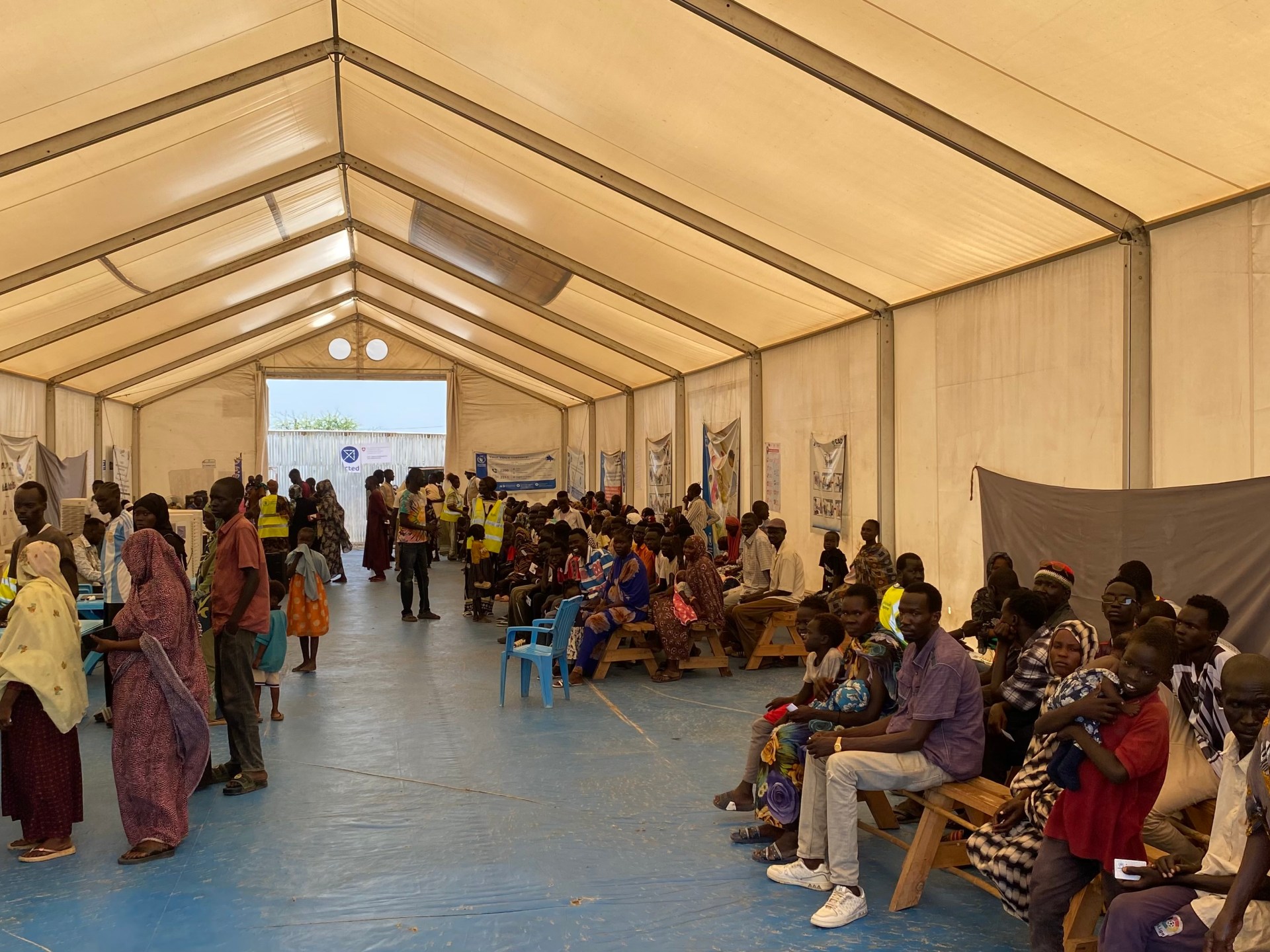

Renk, South Sudan – The arrivals begin before dawn. Women carry children and plastic bags; men walk with almost nothing. Every week, about 3,000 refugees and returnees cross into South Sudan from Sudan.
Many arrive hungry, exhausted and with little or no money. But the food assistance they depend on is also running out.
More than one million vulnerable people could lose access to life-saving food and nutrition assistance by October unless additional resources are secured, according to the World Food Programme (WFP).
In Malakal, one of the agency’s key logistics hubs in the Upper Nile state, food stocks have fallen from 10,000 metric tonnes at this time last year to less than 300 tonnes now. The drop comes as humanitarian agencies face shrinking resources while needs continue to rise, WFP says.
WFP assistant executive director Matthew Hollingworth visited Renk and Malakal in Upper Nile and Pigi county in Jonglei state this month, where he witnessed firsthand the pressures facing communities already struggling with conflict, displacement, hunger and climate shocks.
Hollingworth told Al Jazeera that the war in Sudan had driven up prices and put additional pressure on a country already stretched by the influx of refugees.
“The war in Sudan has been catastrophic for the north of this country. Prices have gone so much higher due to the complexity of importing goods from Sudan,” he said. “Moreover, the influx of refugees [comes] to a country that is really stretched when it comes to helping them.”
Advertisement
In Renk, Hollingworth saw the effects of drought alongside areas still affected by flooding.
“It all comes at the time when the international community has a lot less to give, and we don’t have the same resources we used to have,” he told Al Jazeera.
“On the other side, the government of South Sudan has to consider the issue of illegal checkpoints that prevent us from being able to get everywhere. We need to reach vulnerable people across the country.”

Peter Maker, a displaced person in Pigi, said insecurity and the arrival of people displaced from other areas had made it difficult to farm or find work.
“We face major challenges due to national insecurity and an influx of people from other areas. Our main issues are insecurity and lack of access to farmland,” he told Al Jazeera.
“Although I am able-bodied and qualified to work, insecurity prevents me from travelling for opportunities or farming safely outside, leaving us heavily reliant on the UN and aid.”
Maker said longer-term solutions were needed and warned that further cuts or blockages to assistance would be devastating. He attributed much of the local suffering to political leadership and divisions between communities, while saying people currently survive by sharing resources, relying on God and receiving occasional aid.
A border under pressure
Renk, in Upper Nile state near the border with Sudan, has become a major entry point for people fleeing the war that erupted there in April 2023.
More than 1.4 million refugees and returnees have crossed into South Sudan since the war erupted in Sudan in 2023, according to the World Food Programme. Many arrive after journeys marked by checkpoints, extortion and violence, with little idea of what comes next.
![Refugees and returnees are registered at the transit centre in Renk, South Sudan, after crossing from Sudan, as humanitarian agencies struggle to keep up with growing needs. [Ala Kheir/Al Jazeera]](https://www.aljazeera.com/wp-content/uploads/2024/04/8_-Sudan_UNHCR-Ala-Kheir-1713088727.jpg?w=770&resize=770%2C513&quality=80)
Zainab Musa, a mother of six staying at a transit centre in Renk, recently crossed from Sudan. She said conditions were difficult and there was little food.
“The humanitarian situation is hard and there is nothing to eat, just hunger,” she told Al Jazeera. “I thought of moving from the border at Jodha to the transit centre to look for help.”
Musa said she planned to travel to her grandfather in Bunj, in Maban county, in Upper Nile.
Advertisement
The transit centres in Renk were not designed for the scale of arrivals they are now receiving. Families wait for onward transport to Malakal or other parts of South Sudan, while some remain for months.
The WFP has been forced to reduce rations and cut support as funding has dried up.
In August, the WFP and the United Nations High Commissioner for Refugees (UNHCR) warned that more than 650,000 refugees and asylum seekers were at risk of losing food assistance. They said food and nutrition assistance for the most vulnerable 240,000 refugees was expected to run out in September without additional funding.
Nura Mohammed Ahmed, a Sudanese refugee, said hunger and a lack of adequate nutrition were already taking a heavy toll at the transit centre.
Malakal’s fragile refuge
Malakal has hosted families displaced by conflict and disaster for years.
The former Protection of Civilians site, redesignated as an internally displaced people’s settlement earlier this year, hosts nearly 40,000 displaced people across more than 6,000 households. Many have been displaced for years.
But basic services are also coming under pressure.
The International Organization for Migration (IOM) has warned that water, sanitation and hygiene services in Bentiu and Malakal are at risk because of funding shortfalls. Without drainage pumping and dyke maintenance, Malakal also faces a heightened risk of flooding during the rainy season.
Najah al-Tayieb al-Fadhul, a Sudanese refugee and mother of four, arrived at a transit centre in December 2023 after her husband was killed.
“My husband was killed by the Sudan armed forces in front of me, and I could not stay with my kids there because the situation was traumatising,” she told Al Jazeera.
“I entered South Sudan, and I have tried my best to hustle and earn some small job with the humanitarian organisations based in Renk.”
Al-Fadhul said hunger, sickness and malnutrition were part of daily life.
![Sudanese refugees and South Sudanese returnees gather for water at a transit centre in Renk, South Sudan [Luis Tato/AFP]](https://www.aljazeera.com/wp-content/uploads/2024/02/AFP__20240220__34JQ2NH__v1__Preview__SsudanSudanConflictRefugees-1708493401.jpg?w=770&resize=770%2C514&quality=80)
“There are massive cases of hunger, sickness and malnutrition among the children,” she said. “Even my child has a heart disease, and I cannot afford to treat him.”
She said she sometimes earned about $2.50 a day from work in the market, but struggled to find stable employment despite having a college degree.
“The humanitarian situation is worsening despite securing a job with one of the organisations,” she said. “WFP only helped us here with the small ration for the children in particular. Elders and most individuals lack energy to work due to hunger.”
The funding gap
The WFP says it faces an immediate $86m funding gap and a $416m shortfall over the next six months, threatening its ability to assist refugees, displaced people and vulnerable host communities.
For the wider population, the hunger crisis is already severe. The WFP says 7.8 million people, more than half of South Sudan’s population, face high levels of acute food shortage, while 2.2 million children are acutely malnourished.
Advertisement
The WFP’s current South Sudan emergency response also lists a $258m funding shortfall for the remainder of 2026.
![Children at a Plan International child-friendly space in Renk, South Sudan, where they receive psychosocial support and take part in recreational activities. [Peter Caton/Plan International]](https://www.aljazeera.com/wp-content/uploads/2024/02/PLAN_SS23_day2_fff_31084-1707400307.jpg?w=770&resize=770%2C577&quality=80)
For people arriving from Sudan, the crisis continues after they cross the border.
Nura Mohammed Ahmed put the choice facing some refugees in stark terms: “Many people died here because of hunger and lack of nutrition. There’s nothing, or food that can give us strength. The only solution is to return to war-torn Sudan despite the risks, or die here from hunger.”
Related News
Is it a missile? Is it a drone? What’s the Pelican used by Ukraine?
Early in-person voting begins in the 2026 US midterm elections in Virginia
Mapping Israel’s 300 checkpoints: Where they are and how they work