

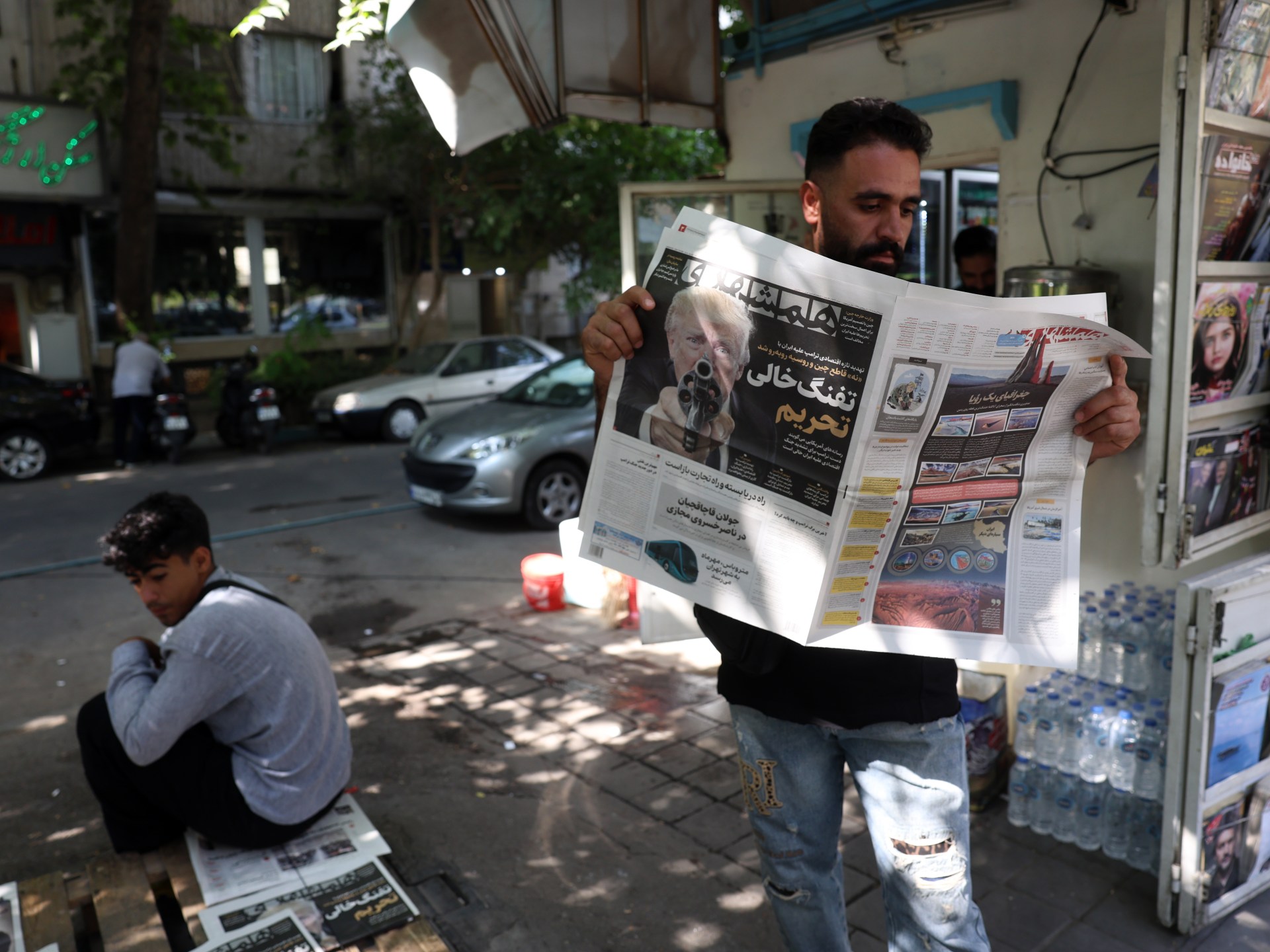

Iran has threatened to treat nearby countries as enemies and target their interests if they join a United States campaign to cripple its economy.
Mohsen Rezaei, secretary of Iran’s Supreme National Security Council, issued the warning in a Saturday interview with state broadcaster IRIB.
- list 1 of 3Iranian president says time to end war with US from ‘position of strength’
- list 2 of 3Iran says new US sanctions violate sovereignty of other states
- list 3 of 3Iran grants permission for some Iraqi oil tankers to pass through Hormuz
end of list
“We’re telling all nearby countries not to join the US economic war. Otherwise, we will consider them as enemies,” Rezaei told IRIB.
His remarks come on the heels of escalating economic threats from the administration of US President Donald Trump.
On Wednesday, Trump announced his government would undertake the “most crushing economic operation” yet against Iran, as part of ongoing hostilities between the two countries.
The US and Israel have been locked in a war with Iran since February 28, when the two allies launched an initial volley of attacks against Tehran.
In addition to threatening Iran’s economy this week, Trump pledged “tremendous economic consequences” for any country that gives Iran “any type of lifeline”.
His Treasury secretary, Scott Bessent, echoed his threats the following day, saying, “You’re either with us or against us.”
In Saturday’s interview, Rezaei described Iran’s regional strategy as a three-stage sequence, which would start with efforts to de-escalate tensions with neighbouring countries.
“First we negotiate. Then, we try to separate them from America with pleasant language, because we are not really looking to expand the war,” he said.
Any countries that continue to side with the US would then be given time to reconsider, he said. “But in the third stage, we will definitely act.”
Advertisement
While the US has not stopped its military operations against Iran, Rezaei suggested that the Trump administration was betting that economic pressure would fracture Iranian society, forcing the war to come to an end.
“They hope that, if possible, they can break our unity with economic pressure and a group of protesters will take to the streets, and in a way, they will come to the aid of American F-35s,” he said, referring to a kind of military aircraft.
Negotiations to end the conflict have stalled in recent months, following the failure of a June 17 memorandum of understanding (MoU) that called for an “immediate and permanent termination of military operations”.
Control over the Strait of Hormuz, a major shipping lane off the coast of Iran, has become an enduring sticking point between the US and Iran.
Iran quickly moved to shut down traffic through the strait early in the war, sending the price of goods like oil and fertiliser skyrocketing.
Countries in the Middle East that were previously reliant on the strait for exports have started to pursue substitute trade routes.
But Rezaei warned that Iran would target those alternative oil-shipping routes out of the Gulf if regional states took part in the US’s plans of economic warfare.
Iran’s Ministry of Foreign Affairs on Saturday also decried the incoming US measures as an assertion of “extraterritorial sovereignty” over United Nations member states.
Tehran has also reportedly considered widening its target list beyond the Middle East, with media outlets reporting it could strike US allies in Europe who have supported Trump’s operations.
Related News
Russia-Ukraine war: What is Europe’s new ballistic missile shield plan?
Crews recover 19 bodies from rubble of destroyed Gaza building
Lebanon ends executions: Where does the death penalty still exist in 2026?