
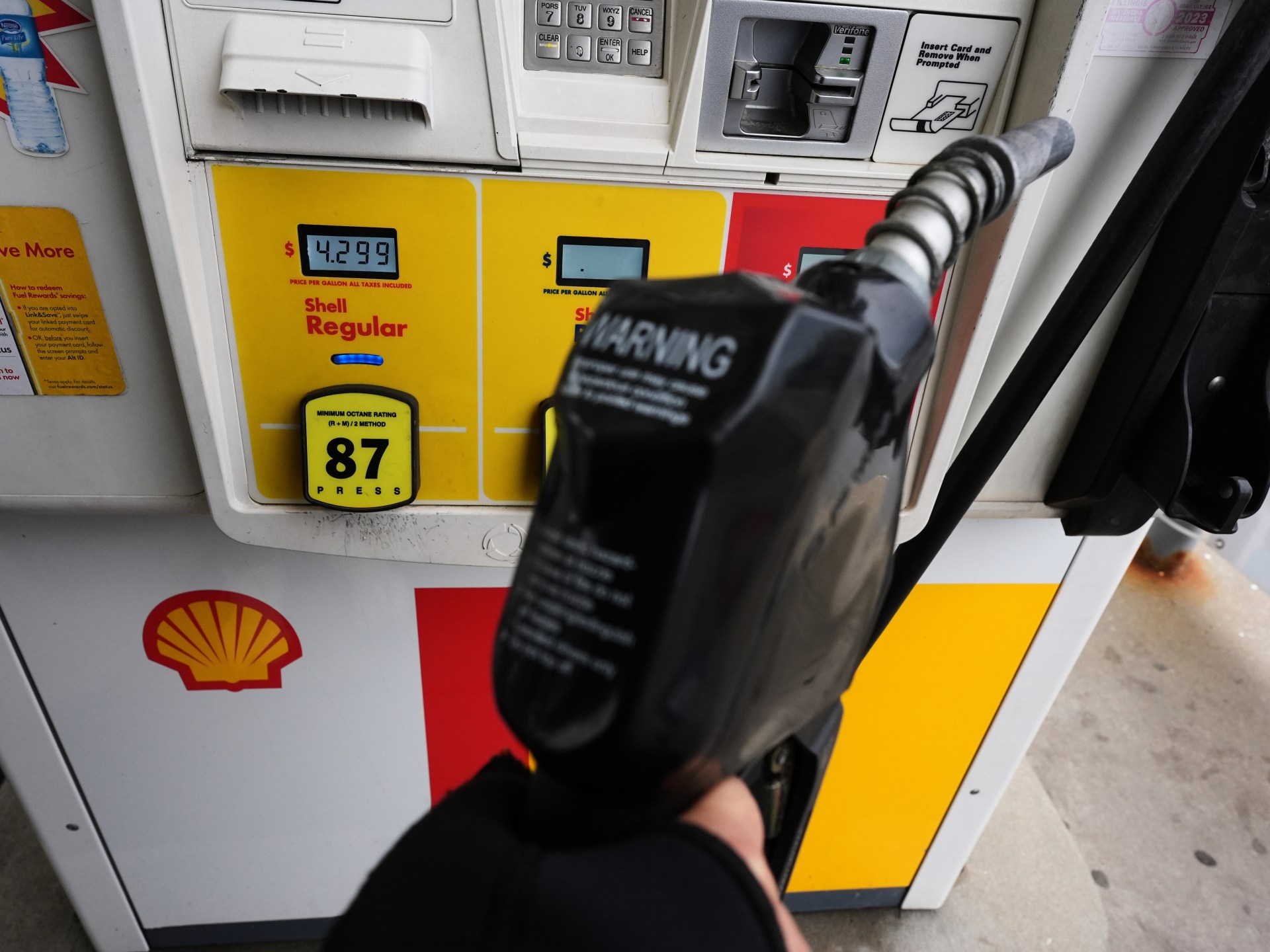

The widening conflict in the Middle East has pushed the price of benchmark Brent crude past $100 for the first time since May, the highest in nearly two months.
Oil prices increased for a fifth day on Thursday after Yemen’s Houthis said they struck Saudi Arabian oil tankers in the Red Sea amid escalating violence between Iran and the United States.
- list 1 of 4How shipping insurance rates are rising, as Hormuz, Bab al-Mandeb shut down
- list 2 of 4Yemen faces a new challenge amid prospects of confrontation
- list 3 of 4Yemen’s Houthis claim attack on two Saudi oil tankers
- list 4 of 4Iran, Gulf hit as Hormuz, Bab al-Mandeb close: What’s the latest?
end of list
The latest attacks by the Houthis risk further disrupting global oil shipping as the Red Sea is another strategic waterway that oil companies use to transport their crude from the Middle East as the Strait of Hormuz – a key route for global energy shipments – remains effectively closed.
The prospect of higher oil prices also raises the possibility of higher inflation and interest-rate hikes, adding to weak sentiment, analysts said.
“Investors are in a wary mood… as fresh jitters of worry about the ongoing energy crunch hit sentiment,” said Susannah Streeter, chief investment strategist at Wealth Club.
“With both the Strait of Hormuz and the Red Sea now under increasing pressure, markets are bracing for the possibility that the conflict could disrupt key energy routes, [and] keep oil prices elevated,” she added.
Amid renewed conflict between Iran and the US, Yemen’s Houthis have potentially opened a new front in the war by targeting vessels carrying Saudi oil in the Bab al-Mandeb strait after warning of a naval blockade on shipments from Saudi Arabia.
The Houthis attacked two Saudi Arabian oil tankers in a military operation, the Yemeni group said on Thursday, with a Saudi news agency later confirming one of the two vessels was ablaze after an assault while sailing in the Red Sea.
Advertisement
US President Donald Trump has threatened a “major military punishment” to the Houthis if they continue to attack ships.
A ceasefire between Iran and the US agreed in mid-June has all but collapsed, with fighting erupting again over the strategically important Strait of Hormuz.
The US military launched fresh strikes on military targets in Iran for the 12th consecutive night, while Iran continued to fire at US allies and military assets across the region on Thursday.
Iran’s Islamic Revolutionary Guard Corps (IRGC) said the Strait of Hormuz is under their control and “completely closed”, warning that no tanker would be allowed to enter or leave without coordination with Iran.
Goldman Sachs said Brent might exceed $120 a barrel in the fourth quarter and average $100 next year if the Strait of Hormuz remains disrupted through next year, with tensions over the Bab el-Mandeb Strait and Suez Canal adding to the crisis.
Goldman expects oil prices to retain most of their recent gains through July and August as global inventories continue to decline, supported by lower Middle East production, seasonal summer travel demand and a sharp slowdown in releases of strategic petroleum reserves.
Related News

Far-right leader Le Pen starts campaign, faces mixed reactions in France

Palestinian legislative elections set for November 28
US says more than 1,400 infected by parasitic Cyclospora illness outbreak