

India’s Rashtriya Swayamsevak Sangh (RSS), the ideological fountainhead of the Hindu far right, says it is organising visits to the United States and other Western countries to bolster its public image globally and dispel claims it is involved in violence against religious minority groups in India.
The visits announced on Tuesday come amid international criticism regarding minority rights in India and a few months after a US federal agency published a report accusing the group of carrying out acts of violence against minorities for decades.
Here is more about the RSS, and what’s behind the visits to Western nations.
What is the Rashtriya Swayamsevak Sangh?
The RSS is a right-wing Hindu volunteer organisation founded in 1925 by physician and Hindu nationalist Keshav Baliram Hedgewar in Nagpur, modern-day Maharashtra.
Rashtriya Swayamsevak Sangh, sometimes called the Sangh for short, is Hindi for National Volunteer Organisation.
The RSS works across society, operating schools, hospitals, magazines and publishing houses, to advocate for the idea of Hindutva, a Hindu supremacist idea that aims to turn India from a constitutionally secular state into a Hindu one.
The RSS describes itself as a “Hindu-centric civilisational, cultural movement” that aims to “carry the nation to the pinnacle of glory”. It leads a network of more than 2,500 right-wing Hindu organisations called the Sangh Parivar, Hindi for RSS family.
“RSS is known as a fascist organisation because if you look at the writings of the first ideologues of RSS, they bring inspiration from Mussolini and Hitler,” Apoorvanand, a Hindi professor at the University of Delhi who writes literary and cultural criticism, told Al Jazeera.
Advertisement
BS Moonje, a Hindu Mahasabha party leader and mentor to Hedgewar, met Italian dictator Benito Mussolini in 1931, openly admired fascist youth and military organisations and saw them as a model for organising Hindu society.
MS Golwalkar, the second RSS chief, wrote a book in 1939 titled We, or Our Nationhood Defined, in which he cited Nazi Germany’s treatment of minorities as an example of preserving racial or national purity.
“You will find admiration towards the policies of Hitler. This is how they wanted to deal with the Muslims and Christians in India,” Apoorvanand, who goes by his first name, said.
“In the present times, their source of inspiration is Israel because Israel is also following the same policy towards Muslims and Christians – to eliminate them completely.”
The RSS has been banned in India several times, including in 1948 after a former member assassinated independence leader Mahatma Gandhi.
The RSS is often described as the ideological mothership of India’s ruling Bharatiya Janata Party (BJP). The BJP was formed in 1980 by former leaders of the Bharatiya Jana Sangh (BJS), including Hindu nationalist leader and poet Atal Bihari Vajpayee, after their split from the Janata Party coalition.
The BJP first came to power briefly in 1996 with Vajpayee as prime minister, but he resigned after 13 days when he failed to gain support for his government from a majority of members of parliament. He won again in 1998 and served as prime minister for 13 months before losing a no-confidence vote. Vajpayee later served a stable term from 1999 to 2004.
Current Prime Minister Narendra Modi, who has been a member of the RSS since 1972, began his first term in 2014, marking the first time the BJP had won a single-party majority in the Lok Sabha, the lower house of the Indian Parliament. In June 2024, Modi was sworn in as India’s prime minister for a third term. Modi, 75, joined the BJP in 1987.

Are hate crimes against minorities on the rise in India?
In 2025, incidents of hate speech against minorities in India, including Muslims and Christians, rose by 13 percent, according to the India Hate Lab, a United States-based research group. The majority of these instances occurred in states and union territories governed by the BJP.
Advertisement
Since 2015, a number of Muslims in India have been lynched by mobs during disputes about herding cattle or over allegations of eating beef. They have also fallen victim to targeted attacks.
Besides hate crime against Indian Muslims, there has been a marked spike in hate crimes against Christians in India recently. According to the India Hate Lab report, hate speech events targeting Christians rose from 115 in 2024 to 162 in 2025, a 41 percent increase.
Christian churches and prayer meetings have also been subjected to attacks in India.
Many observers lay the blame for this rise at the feet of the BJP and the RSS, which deny that they are responsible.
“What we’re seeing is a disturbing escalation in hate crimes, violence, bulldozer demolitions, discriminatory laws and hate speech targeting minorities along with the state using its full might, including the SIR, to systematically disenfranchise minority communities,” Raqib Hameed Naik, founder and executive director of the US think tank, the Center for the Study of Organized Hate (CSOH), told Al Jazeera.
The SIR, or special intensive revision, is a revision of voter rolls that began last year. Critics of the exercise have said it has disproportionately removed Muslims and other minority communities from the rolls.
“What RSS General Secretary [Dattatreya] Hosabale has been saying, including denying any persecution of minorities, directly contradicts facts on the ground. It contradicts research and data from numerous international human rights organisations, including ours,” Naik said.

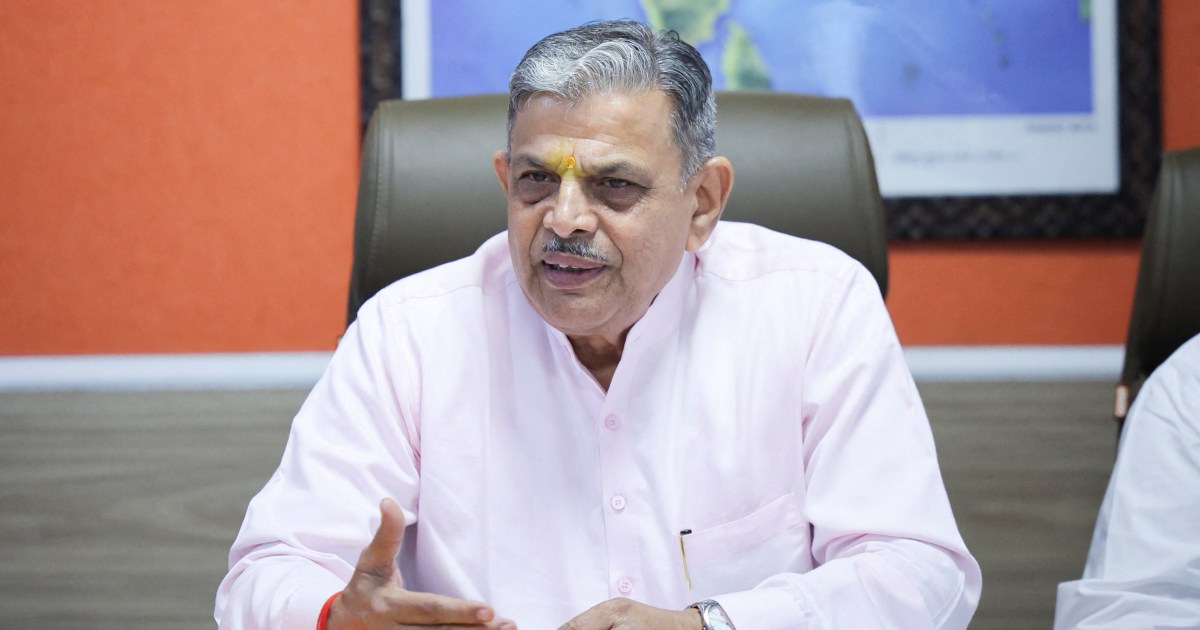
Hosabale said at a rare briefing with foreign media in New Delhi on Tuesday that he had been speaking to gatherings in the US, Germany and the United Kingdom to “dispel certain misgivings and misconceptions about the RSS”.
Speaking from the new 12-storey RSS office in New Delhi, Hosabale said the main allegations against the RSS were that the organisation was a “paramilitary organisation” that promotes “Hindu supremacist things” and “others have become second-class citizens”.
“The fact is entirely different,” he said.
Hosabale met with academics, policymakers and business leaders during his trips to the UK, US and Germany in April.
He spent six days in London and Rugby in central England, engaging with organisations including Chatham House, the Royal Institute of International Affairs and the International Centre for Sustainability in the City of London, according to the RSS website.
The website said a dinner with members of parliament was held that was attended by representatives of the Conservative Party, the Labour Party and the Liberal Democrats.
After this, he visited the US, where he engaged with the Indian American community in multiple cities over 10 days. Hosabale also conducted discussions with the Hudson Institute, a Washington, DC-based conservative think tank.
Apoorvanand told Al Jazeera that the Indian Hindu diaspora is becoming financially powerful in the US and other countries. Diaspora supporters of the RSS help fund the organisation.
Advertisement
“While enjoying all the rights in the country they’re in where they have citizenship, they want India as a Hindu country,” he said.
After the US trip in April, Hosabale went to Germany for two days, where he met with German policy institutions and the Indian community. These included the German Institute for International and Security Affairs, a Berlin-based foreign policy think tank advising the German government, and the Konrad Adenauer Foundation, a political foundation linked to Germany’s centre-right Christian Democratic Union party.
“It is a dream of the RSS to create a network of right-wing conservative organisations worldwide,” Apoorvanand said.
Hosabale said on Tuesday that RSS leaders would continue to visit Europe as well as Southeast Asia and other regions to raise awareness about the organisation.
The RSS visits followed the publication of a report by the US Commission on International Religious Freedom (USCIRF) in November. It said the RSS “has been involved in acts of extreme violence and intolerance against members of minority groups for decades”.
“RSS’s international outreach is essentially a knee-jerk reaction to the USCIRF recommendation to impose targeted sanctions against the organisation and its leaders for their role in the systematic persecution of minorities,” Naik told Al Jazeera.
The USCIRF is a bipartisan US federal body that tracks religious freedom worldwide and advises the president, the secretary of state and Congress on related policy.
“This recommendation came from a bipartisan body. That’s what makes it such a significant blow,” said Naik, who founded HindutvaWatch.org, a real-time database tracking hate crimes and human rights abuses in India.
Apoorvanand said several organisations within the European Union and the US have been investigating the state of minority rights in India.
If recommended sanctions against the RSS and its leaders are enacted, that could spell the collapse of its network, Naik added.
“It would make the RSS a pariah, including among diasporic Indians, some of whom have played a major role in funding and sustaining the organisation, especially before Modi came to power in 2014,” he said.
The RSS has “no option but to send their leaders to the US and other countries to do damage control and to push a counternarrative against the sanctions discourse that’s been gaining ground in policy circles,” he added.
Related News
Trump-Xi summit: China’s help in Iran may require US concessions

Iran says US military killed five civilians in attacks on passenger boats
Modi’s party poised for big wins in Indian state elections