
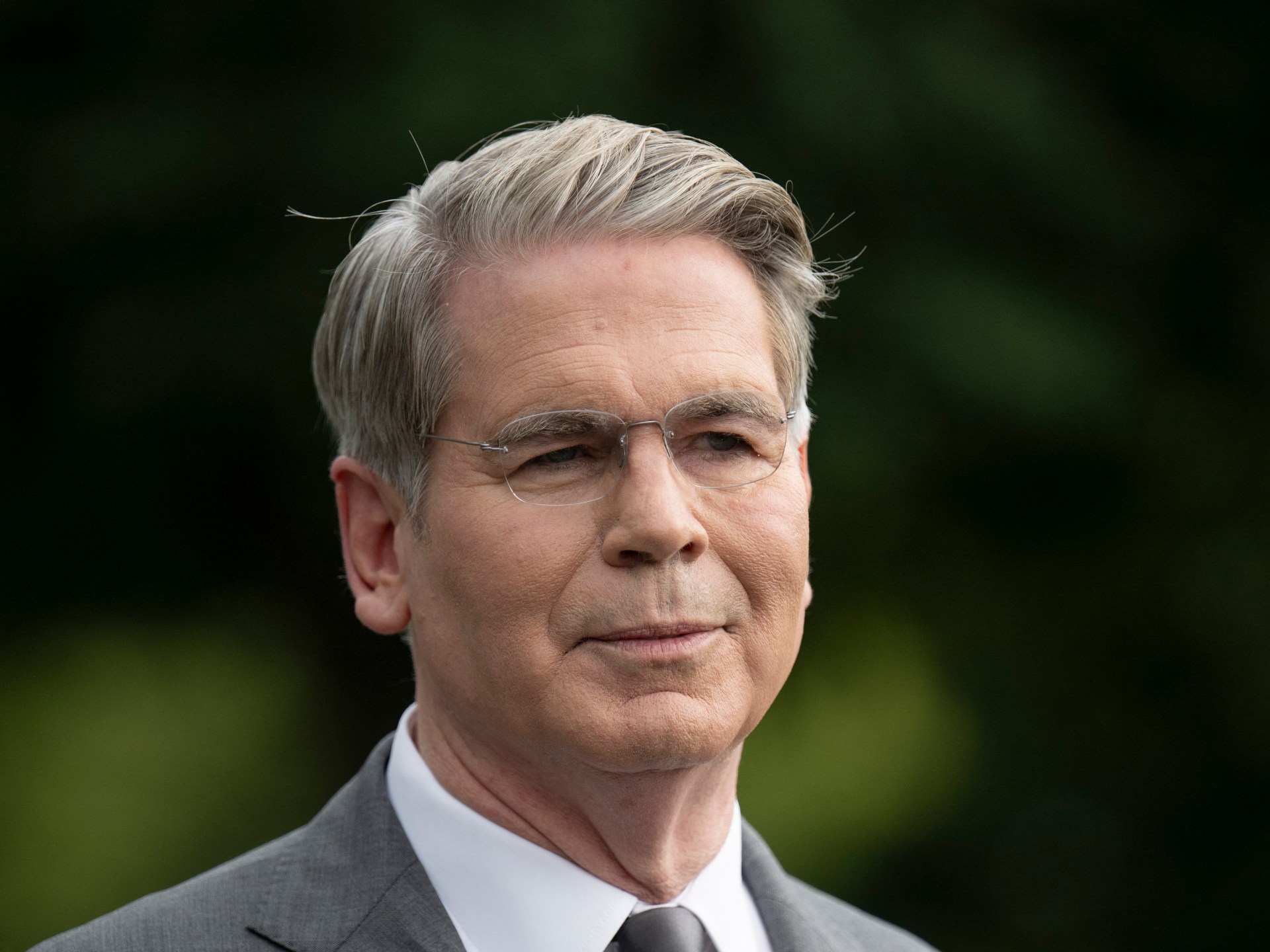

United States Treasury Secretary Scott Bessent has said that a new series of economic measures will “collapse” the Iranian government, calling on countries to join the effort.
Bessent told the news service CNBC on Thursday that the US would apply the “toughest sanctions in history” on Iran, its adversary in a nearly six-month-long war.
- list 1 of 3How China and Russia could hobble Trump’s plans to isolate Iran
- list 2 of 3‘Tremendous costs’: Can Trump stop other countries from trading with Iran?
- list 3 of 3Are ships passing Hormuz more willing to defy Iran or US? What data shows
end of list
“It is a one-two punch. We have the blockade [on Iran], and we are going to have the toughest sanctions in history,” Bessent said. “It is going to work in Iran, and we are going to collapse this regime.”
He then offered a warning to the members of the international community that they too could face economic penalties if they continue to trade with Iran.
“We’re going to them and saying: You’re either with us or against us,” Bessent said. “If you insist on doing business with them — either transferring money, buying oil, doing seaborne ship transport — then the US Treasury and the US government, they will put its full might and force towards enforcing against you.”
He billed the US’s strategy as the “greatest coordinated economic isolation in the history of the world”.
“It is time for our allies and the rest of the world to make a decision,” Bessent added.
The secretary’s comments follow an announcement from US President Donald Trump a day earlier, promising “the most crushing economic operation ever taken against any country” would be unleashed on Iran.
He also threatened “tremendous consequences” for any country that continues to engage economically with Iran.
But what form such penalties could take – and whether they would be applied to powerful countries like China – remains to be seen.
Advertisement
Asked whether China would be targeted, Bessent declined to give a direct answer on Thursday, saying instead that some conversations are best conducted “in private”.
He suggested that all countries should share an interest in isolating Iran, citing the economic impact of Iran’s closure of the Strait of Hormuz, a crucial route for the export of Middle Eastern oil.
Iranian forces have restricted passage since the war began on February 28, when the US and Israel launched an initial volley of attacks.
Prior to the war, traffic flowed freely through the waterway. Reopening the strait has since become a key US aim in ceasefire negotiations, with global oil prices rising since the start of the war.
The conflict has also spurred tensions between the US and its allies, many of whom declined to participate directly in the war effort. Trump has repeatedly lashed out at those countries for not doing enough to help.
Bessent on Thursday reiterated the Trump administration’s position that defeating Iran would have benefits for countries the world over.
“We are confident that everyone wants the strait reopened, and for energy prices to come back down,” Bessent said. “Keep in mind that the Chinese get 50 percent … of their energy from inside the Gulf. So it would do them a big service to get with the programme.”
The US has long sought to isolate and weaken Iran, even before the start of the current war.
On Thursday, for instance, the Trump administration expanded the sanctions against Iran and its allies by designating 10 people associated with Hezbollah, the Iran-backed Lebanese group.
Among the 10 targeted for sanctions was a Turkish businessman, accused of helping to funnel funds to Hezbollah’s base.
But while decades of sanctions have weakened Iran and its allies, critics have been sceptical of their effectiveness in achieving US priorities in Iran, like regime change.
Related News
Former emir of Qatar, Sheikh Hamad bin Khalifa Al Thani, dies at 74
Balogun, Garrincha and Pinochet: FIFA’s controversial World Cup decisions
Iran war live: Trump vows to make Hormuz US territory ‘pretty soon’