

The administration of United States President Donald Trump has issued subpoenas against journalists from The New York Times, in what advocates say is an escalating attack on the free press.
Late on Friday, the Times reported that at least four of its reporters have received subpoenas, some delivered to their homes by federal agents.
- list 1 of 3BBC ‘determined to fight’ Trump lawsuit over Panorama documentary
- list 2 of 3Trump sues BBC for $10bn over edited 2021 US Capitol riot speech
- list 3 of 3BBC files motion asking US court to throw out Trump’s $10bn lawsuit
end of list
Those subpoenas compel them to testify before a grand jury in Manhattan on Wednesday.
“The appearance of federal law enforcement agents on the doorstep of news reporters should shock the conscience of any American who believes in the Constitution and the press freedom it protects,” said David McCraw, the newspaper’s lawyer, in a statement quoted by the Times.
News of the subpoenas prompted outcry from leading news groups including the Committee to Protect Journalists (CPJ), which demanded their withdrawal.
“The subpoenas are an extraordinary escalation in President Trump’s efforts to threaten and intimidate independent news organizations, and have a chilling effect on the work of journalists across the country,” said CPJ’s chief executive officer Jodie Ginsberg.
The subpoenas were authorised by a top official in Trump’s Department of Justice: Jay Clayton, the US attorney for the Southern District of New York.
Clayton is in line to succeed Bill Pulte as the director of national intelligence, a cabinet-level role Pulte holds on an interim basis. The Senate is set to begin hearings on Clayton’s confirmation next week.
Scrutiny on NATO travel coverage
At issue is The New York Times coverage of Trump’s return flight from the 2026 NATO summit in Ankara, Turkiye, this week.
Advertisement
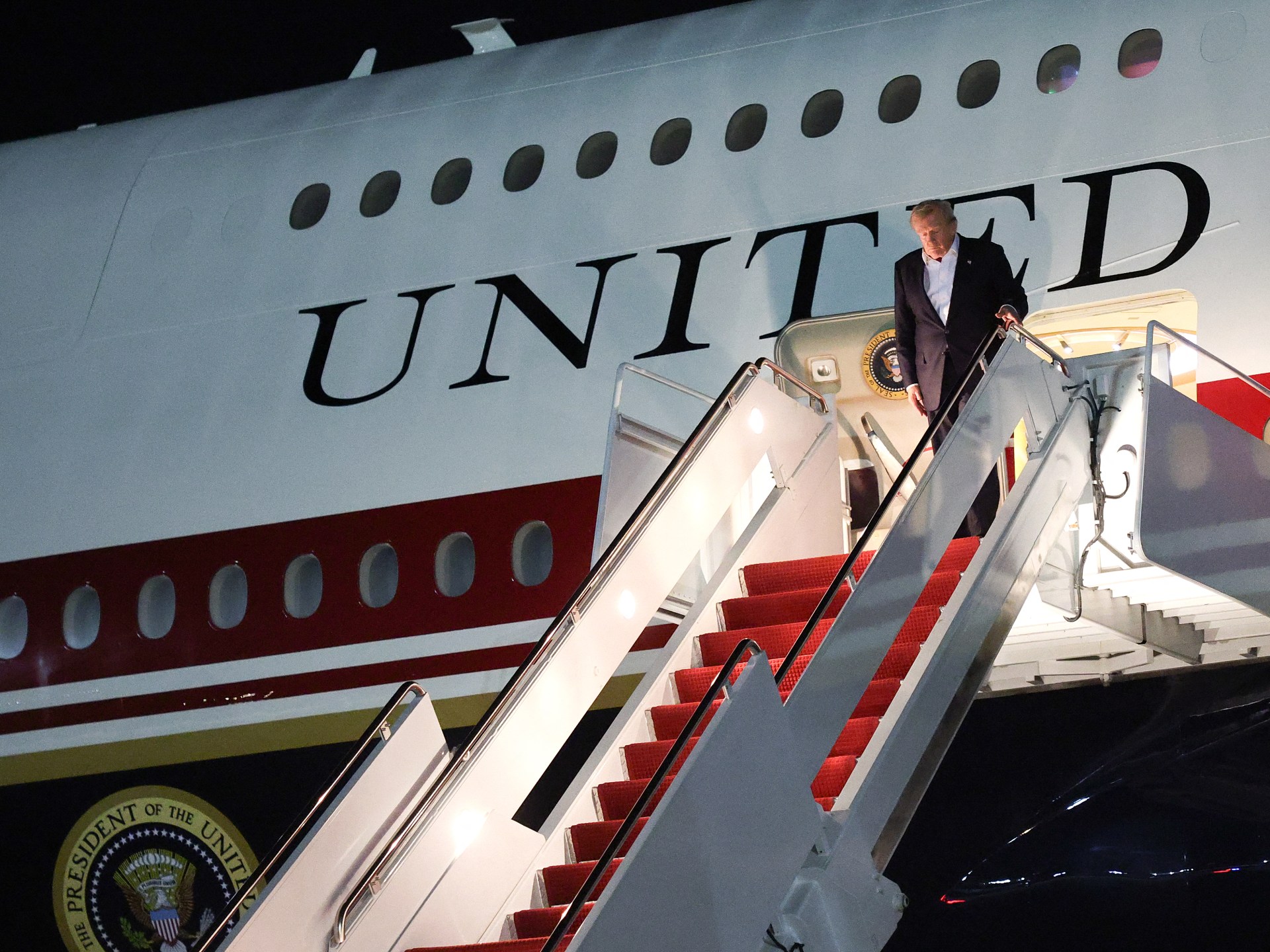
While Trump flew to Europe on his new Air Force One, a jet gifted by Qatar and retrofitted by the US military, he left on the old Air Force One.
Trump claimed the switch was made to allow the new jet to visit RAF Mildenhall, an air force base in Suffolk, England, that supports US military operations.
He framed it as an opportunity to allow military members to tour the aircraft.
“It’s going to go to a couple of bases,” Trump said at the time, “so the soldiers can see it because it’s truly magnificent.”
But at the same July 8 news conference, Trump referenced concerns about his safety.
When asked about the airline switch by a reporter from The New York Post, Trump responded, “You know, the life of a president is very dangerous.” He proceeded to add that he’s “number one on the kill list for Iran”.
That same day, The New York Times reported swapped his new presidential jet for his old one because of security concerns, citing anonymous sources. The change reportedly came at the urging of the Secret Service.
Then, the next day, the Times expanded its coverage with a follow-up report, indicating that the new Air Force One lacked the security capabilities of the old jet.
The article anonymously cited two former Air Force officials as saying there would not have been enough time to make the necessary upgrades before the Ankara flight.
It is unclear what modifications have already been made, but experts have estimated that the updates could cost up to $1bn.
Friday’s subpoenas targeted four of the journalists involved in the Times’s reporting on the subject: Eric Schmitt, Tyler Pager, Eric Lipton and Julian E Barnes.
According to the Times, before the subpoenas were issued, the newspaper was contacted by a senior official from the FBI.
That person, who was unnamed, asked the newspaper to hold off on its reporting about Air Force One, citing national security. The FBI official also requested information on the Times’s anonymous sources.
The newspaper, however, declined to provide such information, in line with standard journalistic practice.
A testy relationship with journalists
The subpoenas mark the latest clash between the Trump administration and US media outlets that report on its activities.
Trump himself has a long-running feud with the Times. In September, he sued the newspaper for $15bn in damages, alleging it had defamed him and attempted to “sabotage” his candidacy in the 2024 presidential election, which he won.
After his initial complaint was thrown out as “improper”, Trump refiled it in October.
Advertisement
The Times, for its part, has sued the Department of Defence under Trump over its attempts to impose media restrictions on journalists.
Just this week, the Times also filed a countersuit against the Equal Employment Opportunity Commission, after it alleged the newspaper had discriminated against a white, male employee for failing to give him a promotion.
The Times has described the effort as an attempt to muffle the press, in violation of the free-speech protections enshrined in the US Constitution’s First Amendment.
The Times is not the only newspaper to face legal backlash from the Trump administration. In December, Trump launched a $10bn lawsuit against the BBC, arguing that a documentary it aired misrepresented his speech before the attack on the US Capitol on January 6, 2021.
Trump is also seeking $10bn from The Wall Street Journal over its reporting on a birthday message he allegedly sent to convicted sex offender Jeffrey Epstein. After that suit was thrown out, Trump refiled it in May.
The Trump administration has also taken actions against individual journalists.
In January, for instance, the FBI executed a raid on the house of Washington Post reporter Hannah Natanson, who covered the Trump administration’s efforts to scale back the federal workforce.
The raid came as part of an investigation into a government contractor accused of leaking information to the news media, but at least two judges have barred the Trump administration from using the information it seized from Natanson.
The Trump administration has denied seeking to erode the freedom of the press, instead citing national security needs.
But McCraw, the Times lawyer, argued that, with the latest subpoenas, the White House was trying to restrict “the American public’s right to know how their government is operating”.
“This brazen act should be seen as nothing more than an attempt to prevent the public from knowing what is happening in their country by intimidating journalists from doing their jobs,” he said.
Top Democrats, including Senate Minority Leader Chuck Schumer, also weighed in on the subpoenas, using them to slam Trump as corrupt.
“Donald Trump is one of the weakest, most thin-skinned individuals the world has ever seen,” Schumer wrote on social media.
“Reporters have the right and duty to report the truth. It’s not their fault his foreign-gifted plane is a national security threat. This subpoena is a gross overreach and a disgusting misuse of federal law enforcement resources that should alarm every American.”
Related News
Berlin police shoot dead suspect in car ramming attack on Pride event

Detained by settlers, US Democrat Ro Khanna now faces pro-Israel attacks
‘Sealed in blood’: Where does the China-North Korea alliance stand today?