

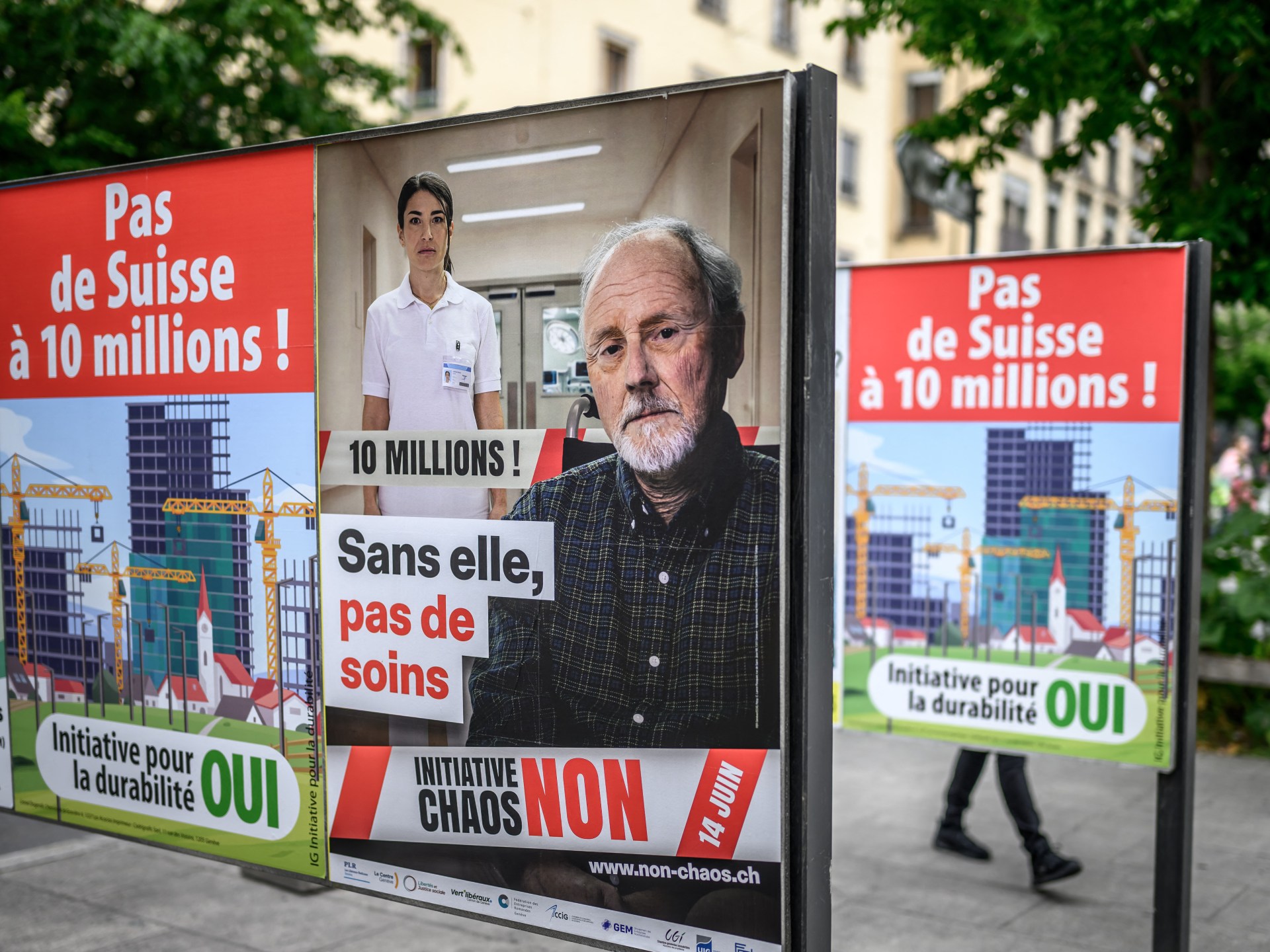

Switzerland is holding a vote championed by the main right-wing party to cap the country’s population at 10 million, a move that could jeopardise its relations with the European Union.
Final ballots were cast on Sunday, after the Swiss People’s Party (SVP) put the measure forward, having fanned anti-migration sentiment over the years.
- list 1 of 4Thousands rally in Rome, Italy for rival pro- and anti-migration marches
- list 2 of 4EU asylum applications down 23% with huge drop in Syrian requests in 2025
- list 3 of 4Thousands attend anti-racism rallies following unrest in Belfast
- list 4 of 4‘A global rupture’: Carney calls for Canada-EU unity before G7 summit
end of list
Driven by concerns on immigration, pressure on public services and housing, the constitutional change pitched by the SVP would mandate that the population must not exceed 10 million by 2050. Official projections put it on track to hit that figure by the early 2040s.
Results of the vote are expected to begin coming in at about midday (10:00 GMT).
Recent polling from the gfs.bern agency suggested it could be a close contest.
If the population reaches 9.5 million before 2050, the government would be forced to restrict asylum, family reunification and residency permits, and may have to scrap Switzerland’s EU deal on the free movement of people.
The SVP says the “sustainability initiative” is necessary because Switzerland’s infrastructure, housing, social programmes, natural resources and way of life have been strained by demographic growth.
The federal government and parliament oppose the idea.
Critics of a population cap say the boom in migration over the last generation has brought foreign labour and skills to sectors such as healthcare, finance, pharmaceuticals, and technology. Some also worry the proposal, if approved, would weaken critical ties with Brussels. The EU is Switzerland’s top trading partner.
Advertisement
Even some SVP figures say the proposal is not meant to stop free movement, but to serve as a wake-up call.
“I don’t want freedom of movement ended,” said Heinz Taennler, an SVP politician and finance director of the canton of Zug.
“Another million people can still immigrate to Switzerland, but the government needs to take action.”
Swiss democracy gives voters a direct say in policymaking through referendums, typically held four times a year.
The Organisation for Economic Co-operation and Development has reported that Switzerland had a foreign-born population of 32 percent as of 2024, behind only Luxembourg and Australia among the group’s 38 member countries.
International migration has long been a sensitive issue in Europe, as nations grapple with an ageing population and increasing anti-foreigner sentiment. While that sentiment in other European countries is focused on migrants from the Global South, most foreigners in Switzerland are Europeans.
Since Switzerland and the EU eased restrictions on citizens living and working across their borders in 2002, the Swiss population has grown by 23 percent, to 9.1 million at the end of last year. Economic output has also increased, up 24 percent over the same period, government data shows.
Swiss voters have repeatedly tackled the immigration issue over the last half-century. Only one such referendum – “against mass immigration” in 2014 – narrowly passed, after campaigners stoked fears about overpopulation and rising numbers of Muslims in the country.
While many countries have limits on immigration, none has ever voted to limit its population, Swiss experts say.
Related News

Why has Belfast erupted in anti-immigrant violence after a knife attack?

UK boards and seizes Russian shadow fleet tanker in English Channel

US confirms it denied entry to Somali referee set to take part in World Cup