
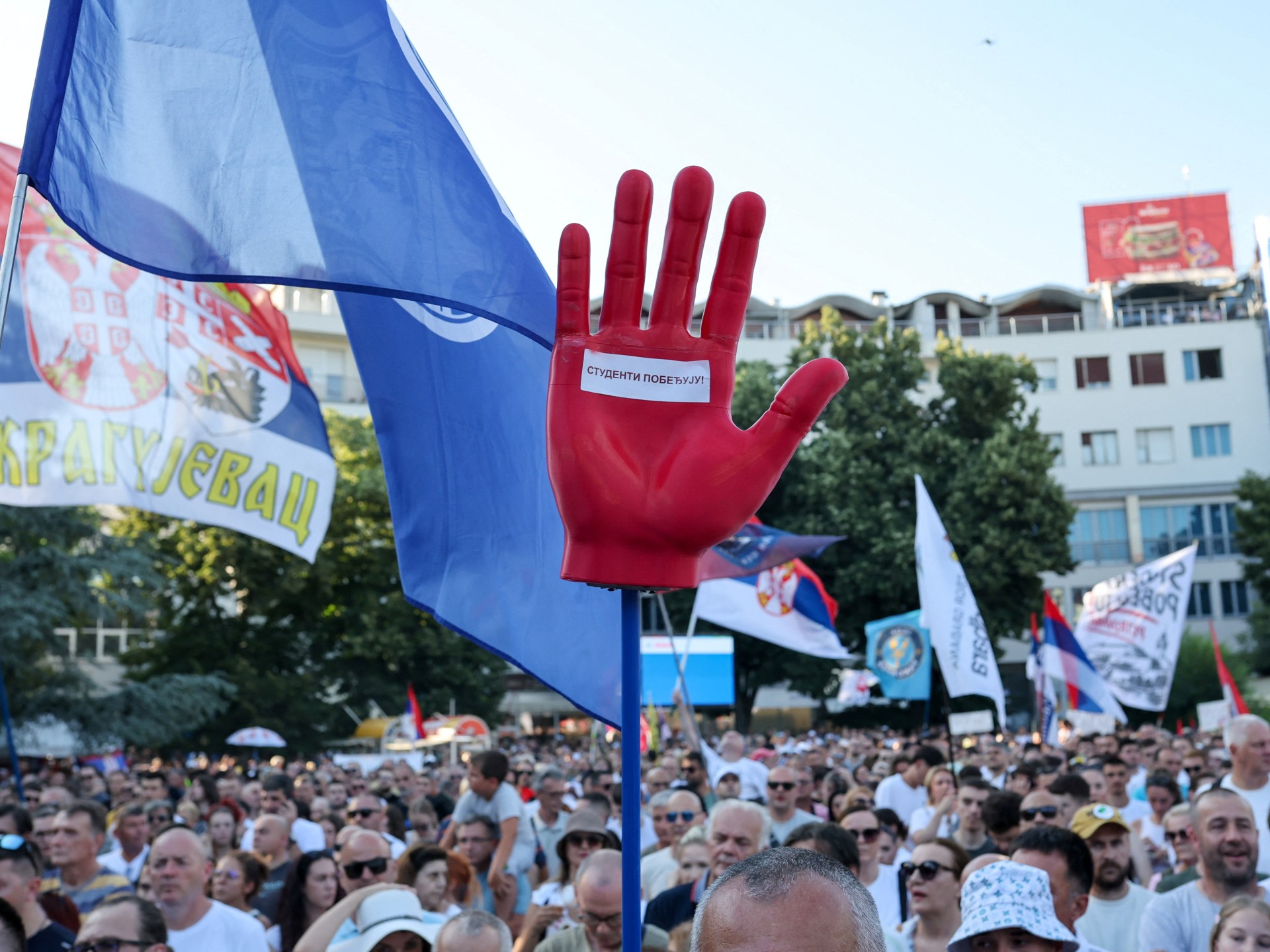

Thousands of protesters have packed the streets of the central Serbian city of Kraljevo, refusing to ease their pressure on President Aleksandar Vucic even after he promised to resign and open the door to early elections.
Vucic announced at a rally in Belgrade on Saturday that he would step down within weeks, a move that would end, at least formally, the dominance of the man who has run Serbia as either president or prime minister for 12 years.
- list 1 of 2Bosnia: The lilies and dragons of the World Cup
- list 2 of 2Serbia’s President Aleksandar Vucic says will resign within ‘weeks’
end of list
Yet there was little sense of relief among the thousands rallying on Sunday in Kraljevo. Under Serbian law, Vucic cannot seek another presidential term in any case and many protesters and analysts expect him to switch to the more powerful office of prime minister and hand the presidency to a loyal ally, keeping his grip on power intact.
![Protesters gather in Kraljevo a day after President Aleksandar Vučić said he would resign, June 28, 2026 [Djordje Kojadinović/Reuters]](https://www.aljazeera.com/wp-content/uploads/2026/06/2026-06-28T172223Z_1845621665_RC243MA8NMFS_RTRMADP_3_SERBIA-PROTESTS-1782670075.jpg?w=770&resize=770%2C513&quality=80)
Far from sounding defeated at the Belgrade gathering, Vucic struck a combative tone, predicting that his right-wing Serbian Progressive Party, which has governed the country for 14 years, would “win more convincingly than ever before” at the next elections.
He set no date either for his departure or for the elections, leaving his opponents uncertain about what comes next. The competing rallies laid bare a country split in two.
At the heart of the anger is a disaster in late 2024, when the roof of a railway station gave way in the northern city of Novi Sad, killing 16 people.

Protesters blame the tragedy on corruption and shoddy work on large state building projects, turning it into a symbol of what they see as a rotten and unaccountable government.
Advertisement
Vucic denies any corruption and has repeatedly cast the protesters as “foreign agents” bent on toppling him.
The campaign has grown into the largest wave of protests since Serbians overthrew the authoritarian leader Slobodan Milosevic in 2000.
Police have rounded up hundreds of people during months of unrest, drawing accusations from the European Union that officers have acted brutally and locked up demonstrators without proper grounds.
Related News
Thirty-two years on, young Rwandans reflect on progress, pain and hope
Gaza health chief urges action to ‘save’ Dr Abu Safia before it’s too late
Kyiv warns Iran against escalation after Ukraine’s Caspian Sea attack