
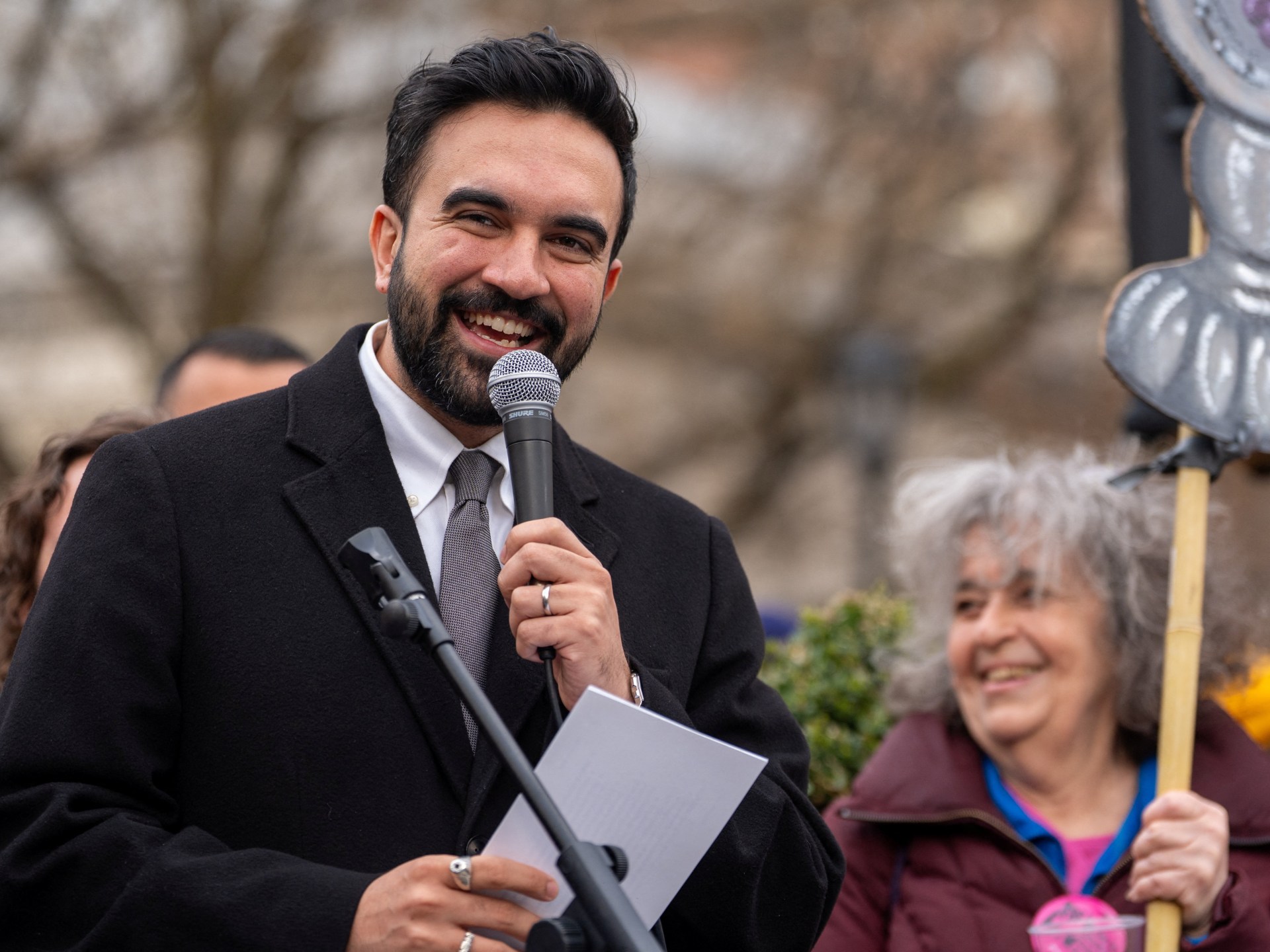

New York – It has been almost 100 days since thousands of supporters braved the blistering cold at City Hall Park to witness the public inauguration of Zohran Mamdani.
As the first Muslim mayor of the world’s wealthiest city, the young Democratic socialist’s win was historically significant. For many, it was a test of whether a campaign platform built on affordability could actually govern a financial capital.
- list 1 of 4Iran says it ‘would be dumb’ for US to let Netanyahu kill diplomacy
- list 2 of 4US led ‘historic’ foreign aid decline in 2025 amid Trump cuts: OECD
- list 3 of 4US fertility rate drops to all-time low, continuing a two-decade decline
- list 4 of 4Iran: Strait of Hormuz open with restrictions
end of list
Mamdani had become a symbol of change for his supporters as he ran for office amid polarised politics, with a message of unity and campaign promises of lower living costs that bolstered his support.
“The only real majority in this country and in this city is that of the working class,” Mamdani told Al Jazeera in an interview at City Hall. “And too many working-class New Yorkers, working-class Americans, do not see themselves and their struggles at the heart of our politics.”
It was his messaging about the struggles of the working class that motivated many of his supporters to the polls last year. New Yorkers faced record rents, higher grocery prices and expensive childcare.
Despite his popularity running on these issues, not everyone was a fan. Mamdani faced fierce criticism from not only his opponents in the race and Republicans nationwide who accused him of being a communist, but also those within his own party.
Democratic Congresswoman Laura Gillen called him too “extreme”, while Democratic leaders like Chuck Schumer and Hakeem Jeffries refused to endorse him despite his growing popularity with voters.
Advertisement
Childcare and potholes
However, his first 100 days have been marked by some major victories, including delivering on one of his signature promises: universal childcare.
Now he’s rolling out a plan to add 2,000 seats in daycare centres, starting in lower-income neighbourhoods, with the promise of taking the burden of expensive childcare off New Yorkers’ shoulders.
The win on childcare was for both the mayor and Governor Kathy Hochul, as they shared a priority that didn’t require tax increases. Together, the two secured $1.2bn to fund the venture from the state’s existing revenue streams allocated in the 2026 fiscal-year budget.
In June, New Yorkers will be able to sign up for spots for two-year-olds and offers for spots will be announced by August.
“These are the things that New Yorkers need, because we’re talking about a city of immense wealth, the wealthiest city in the wealthiest country in the history of the world, where one in four New Yorkers are also living in poverty,” Mamdani said. “And after housing, it’s childcare costs that are pushing New Yorkers out of the city.”
The mayor also found popular success with a drive to fix the city’s potholes. By early April, the city had filled 100,000 potholes, a milestone reached Monday.
“One of the reasons we focus so much on filling 100,000 potholes across the city is that it’s symptomatic of a city government that can actually take care of even the smallest tasks in New Yorkers’ lives, to prove that we can be trusted to take on the biggest problems in their lives as well,” Mamdani said.
But the mayor has also faced scrutiny over the city’s response to brutal snowstorms and the limited progress in ongoing state budget negotiations.
“Well, I think every crisis is an opportunity to not only learn about the tools that the city has, but also learn about the tools the city should have,” he said of the massive snowstorms that hit the city in January and then February. “In the first snowstorm, it became clear that the city did not have a preexisting plan of how to address, whether it be the lack of tagging geometrically, of bus stops, of sidewalks, of crosswalks.”
The city launched a new tool to measure the cost of living in New York, factoring in essentials like food, transportation, taxes and housing. It found that 62 percent of New Yorkers don’t earn enough to cover these costs. On average, families fall nearly $40,000 short. The burden is highest for communities of colour – 77 percent of Hispanic and 65 percent of Black New Yorkers cannot meet the cost of living.
Advertisement
“That’s about five million New Yorkers. This is the most expensive city in the United States of America,” he told Al Jazeera. “And we have to take every single tool that we have to make it more affordable.”
But not everyone agrees that raising taxes is the way to cut costs.
EJ Mahon, an adjunct fellow at the Manhattan Institute, a conservative think tank, pointed out that millionaires in New York already face the highest tax burden in decades.
“If there’s one slogan that has risen to the level of obsession among Mayor Mamdani and other New York progressives, it’s ‘tax the rich’. But here’s the thing: We already tax the rich,” Mahon said in a video post on the conservative think tank’s website last month. “We already impose the highest rates on millionaire earners in more than 40 years, as written in state and city law.”
New Yorker Aria Singer said he worries that billionaires will flee the city if taxes are too high.
“He wants to tax the rich. He doesn’t realize the rich people hire people. They employ people. They employ the masses. When you attack the rich, they move out of the state, they move out of the city, so this whole concept that we are going to help the masses is a little bit foolish,” Singer told Al Jazeera.
Mamdani’s rise was driven by sharply increasing rents – up roughly 25 percent on average since 2019 – and political turmoil under former Mayor Eric Adams, who was indicted in September 2024 on bribery and campaign finance charges.
Many of Mamdani’s other plans, however, depend on raising taxes, creating tension between the mayor and the governor. That strain extends beyond Mamdani’s relationship with the governor, reflecting a long history of friction between the two offices.
The city has limited control over setting its own tax rates. With the exception of property taxes, the mayor is at the governor’s mercy, who would ultimately greenlight it.
And using his political capital with the state assembly, which he was previously a member of, will drive much of his agenda, including his free bus proposal. The city’s bus system falls under the jurisdiction of the Metropolitan Transit Authority (MTA), a state agency, not a city agency.
But because of tax-driven decisions, his success or failure will depend on his ability to put political pressure on the governor, according to Adin Lenchner, a political strategist at Carroll Street Campaigns.
“If he can continue to build that [grassroots support], there will be more and more public pressure to actually execute on those priorities,” said Lenchner of the New York-based political consultancy. “It’s going to be an uphill challenge, but I think he’s uniquely positioned to be able to take off.”
He stressed, though, that it is not a given and requires consistent mobilisation of supporters. Lenchner said that does not always work. For example, Barack Obama was unable to maintain his grassroots support that would have otherwise put pressure on lawmakers standing in the way of his political priorities.
“It’s possible this falls on its face,” Lenchner said.
Advertisement
Locally, Mamdani is focused on housing. The agency that would freeze rents, one of his signature campaign promises, is considering his proposal. His plan, however, would regulate rents for only about half of rental apartments. To alleviate pressure on the rest, his administration is aggressively building more housing across the city, arguing that this will create more competition and drive down prices.
Mamdani’s first 100 days come ahead of the midterms, with candidates like him running across the country on policy or approach. Some primaries are already underway, and a track record is already on the books in New York City. Over the next six to eight months, candidates will be in a position to point to the city as a solid example of what to do, or something they will actively avoid.
“He’s made these issues accessible to New Yorkers and, frankly, to a larger audience across the country, which is why you are now seeing candidates and elected officials across the country use similar approaches,” Democratic strategist Nomiki Konst said.
“What Mayor Mamdani has been able to do is use this platform and these strategies to elevate the everyday functions of the largest administration in the country and make it accessible.”
Republicans have pushed back on the affordability agenda that Mamdani ran on. In December, US President Donald Trump called affordability a “hoax” created by Democrats, and only a month later, he changed his tone, pushing his own affordability plan.
Identity tests
A wave of xenophobic attacks disproportionately targeting the city’s Jewish and Muslim communities took place shortly after he became mayor.
In late January, a car rammed into a Jewish community centre in Brooklyn. In early March, Mamdani was the subject of brazen Islamophobic remarks from a talk radio host who called him a “radical Islam cockroach”.
Only days later, a far-right activist led a rally for far-right, anti-Muslim demonstrators outside the mayor’s residence, called Gracie Mansion.
In response, the New York City Police Department (NYPD) said that counterprotesters identified as Emir Balat and Ibrahim Kayumi threw an “improvised explosive device”. The Department of Justice referred to the incident as an “ISIS-inspired act of terrorism”.
“Violence at a protest is never acceptable,” Mamdani said in response to the chaos that unfolded outside his residence. “The attempt to use an explosive device and hurt others is not only criminal, but it is also reprehensible and the antithesis of who we are.”
As the city moves past the 100-day milestone, the blistering cold of his inauguration has been replaced by the heat of governing a city demanding results.
Mamdani appears to know that his time as mayor will not be measured solely by the number of potholes filled, but by whether his vision for a more affordable New York can withstand the friction of its own politics.
However, the mayor said, filling potholes is a good start.
“I think if you want someone to believe in the promise of a transformative vision of universal childcare, of fast and free buses, you have to first deliver on the thing that diminishes their faith on a daily basis,” he said.
“It may not seem like much, but if you are driving your car or you’re riding your bike and you hit the same pothole every single day, why would you trust city government in its ability to deliver something that you have never seen at that scale, when it can’t even do this?”
Related News
Yemenis fear economic consequences of being dragged into US-Iran conflict
Norway to add more than $11bn to defence budget over 10 years
Burkina Faso military, allies committing ‘horrific’ civilian abuses: HRW