
Inside the talks between student protest leaders and Macron’s government
 23 November 2026
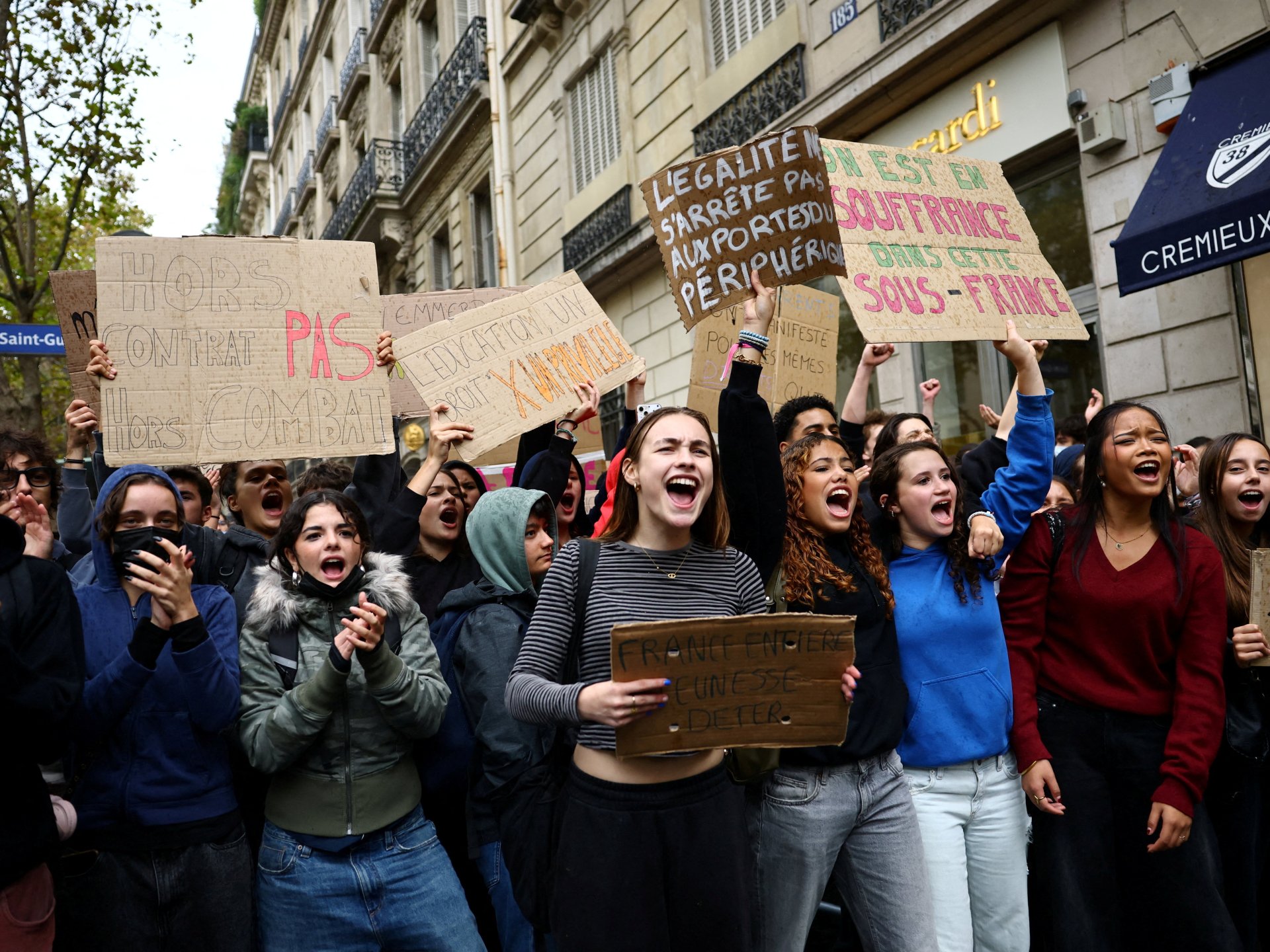

Paris, France – High school student Marius Mensil has participated in several meetings with top officials, including President Emmanuel Macron, Prime Minister Sebastien Lecornu, and Education Minister Edouard Geffray, aimed at addressing the concerns of thousands of protesting students.
“They’re very good at listening to us. They welcome us, smile at us, tell us, ‘Yes, you’re right, your demands are legitimate’, and in the end, they do nothing,” the 17-year-old told co-leader of the French high-school students’ union, Union Syndicale Lyceenne (USL), told Al Jazeera.
- list 1 of 4Young French students who see ‘no change’ keep up protests in Paris suburbs
- list 2 of 4Photos: Tens of thousands rally in France over living standards and wages
- list 3 of 4A tale of two protesters: Young Germans resist military expansion
- list 4 of 4Protests held across Europe over wages, services, high living costs
end of list
Held in government offices in Paris, the meetings have, on occasion, lasted as long as two hours, he said.
“With Geffray, it was mainly an exchange of arguments. We’d present our demands to him, and then he’d try to explain why they weren’t feasible,” said Mensil. “He used very technical language to try to confuse us. Macron and Lecornu were much more attentive. They took notes, smiled and gave us winks – in short, they did everything they could to show us that our demands were being heard. All of this, of course, was just a way to avoid making any concrete commitments.”
The student movement first began at high schools in the overseas territory of Mayotte. Then it moved to mainland France, with a high school in Creteil, a suburb southeast of Paris in the Val-de-Marne region, on September 17. Protests quickly spread to neighbouring Saint-Denis and the rest of France, and were joined by groups with other grievances.
For two months, students have blocked their schools’ entrances and taken to the streets, demanding an overhaul of the education system.
Advertisement
“It’s been clear ever since Macron took office – and even before – that conditions have deteriorated year after year. With every budget, there are fewer teachers. There are cuts to local governments, who manage school facilities,” Mesnil told Al Jazeera. “We’re not asking for five-star restaurants, MacBooks, or castles… We’re asking for enough teachers, buildings where the ceilings aren’t falling on our heads and class schedules adapted to our biological rhythms.
“We’re asking that, once we’ve earned our high school diploma, we can study at university.”
In response to the protests, officials invited high school students to voice their concerns. Since late October, representatives have attended several meetings, but despite some concessions, students say their demands remain unmet.
A key demand is to entirely reconstruct Parcoursup, the university admissions programme. Students claim the system is discriminatory and lacks transparency, with rejected students saying they are unable to find out why they were not accepted. The system and some degree programmes also value the academic standing of an applicant’s high school, meaning top students in disadvantaged areas may be overlooked.
They are also calling for an emergency plan to renovate failing school infrastructure. Some student groups and unions also want more teachers on permanent contracts and an additional 10 billion euros ($11bn) devoted to education.
In response to the protests, the government recruited 920 substitute teachers in early October and plans to hire 3,000 more. Next year’s budget includes an increase to cover more substitute hours for each high school.
The government also agreed to commit 1 billion euros ($1.1bn) per year through 2030 to building renovations, and to offer more opportunities for high school representatives to participate in national education discussions.
When contacted by Al Jazeera, the Ministry of Education responded with a statement that Geffray and the minister of higher education, research and space, Philippe Baptiste, sent to students on October 26.
In that statement, the education minister promised to cap class sizes at 28 students at the start of the next academic year in 2027 at “the most disadvantaged schools”, and reduce specialised course sizes. Although some high school students are still calling for Parcoursup to be abolished, the government has agreed to update the controversial platform “to help you plan your academic path with greater peace of mind”.
“Some measures will be implemented very quickly, while others will be included in the 2027 budget bill, which will be introduced in the coming weeks,” Geffray said.
Advertisement
Mesnil called the measures “a few crumbs”, but believes the concessions show that the student movement is making waves.
“The government is starting to give in,” he said. “Gen Z, together with the workers, have forced Macron to back down on some initial points, and we’re very happy about that.”
Beyond meetings, the government opened “High school students, the floor is yours”, a consultation platform for students to submit their opinions and complaints. More than 100,000 submissions were sent in during the 18 days it was open, starting on October 6. About 70 percent said the current school system is “ill-suited to their needs”, citing days that are too long and intense, with poorly structured schedules.
Many French high school students are in class from 8am to 6pm, with few breaks and heavy homework on top of the course load.
More than half of respondents, 56.3 percent, said buildings were dilapidated, improperly insulated and poorly equipped. Participating students also cited absent teachers, class sizes, the Parscoursup platform and negative mental health effects.
Students in disadvantaged areas say conditions are even worse in their suburbs.

Bilal Narjissi, 17, from the Paul-Eluard school in Saint-Denis and a member of the Renouveau Lyceen student union, took part in recent meetings with government officials and said they do not include many students from less advantaged schools.
“In schools in the suburbs and in rural areas, roofs have collapsed, there are water leaks, rats, and classes with 30 students,” he said. “Young people today are pushed to pursue higher education, but they aren’t given the means to succeed.”
Narjissi has invited a special adviser to the prime minister to visit Paul Eluard.
“It would be truly symbolic if he were to come by and we could take him on a tour of the high school, show him the conditions there, and talk to him,” Narjissi said.
Narjissi described the first meeting with officials he attended as “very relaxed”, saying they seemed “very open to dialogue”.
But he added that the economy, education and labour ministries “were quite firm in their positions – for example, on reforming the baccalaureate,” Narjissi said, referring to the final high school exam.
The 2018 high school reforms by former Education Minister Jean-Michel Blanquer introduced “more subject concentrations, shortened the final exam, and placed greater emphasis on grades”, according to Rafaela Uzan, research associate for Europe studies at the Council on Foreign Relations. “But critics argue the abundance of concentration options exacerbated social stratification and made school days longer,” she wrote in a recent paper.
Narjissi said the exchange with officials “was still fairly constructive”, but he is unsure if the students are really being heard “because, so far, there still aren’t any real, concrete responses to our expectations”.
Until they receive those, students say they will continue to protest.
Advertisement
“We’ve managed to establish a balance of power through our mobilisation,” he said.
Student representatives were scheduled to meet with the prime minister again on Monday.
“We hope there will be announcements that live up to our expectations. We’re happy to attend these meetings, but if it’s just to talk and, ultimately, there are no concrete political results, then there’s no point,” Mesnil said.
Related News
Trump says he may move White House press corps to new location
Bangladesh forms wage board as garment workers protest
South Korea’s stock market tumbles as AI bubble fears mount