

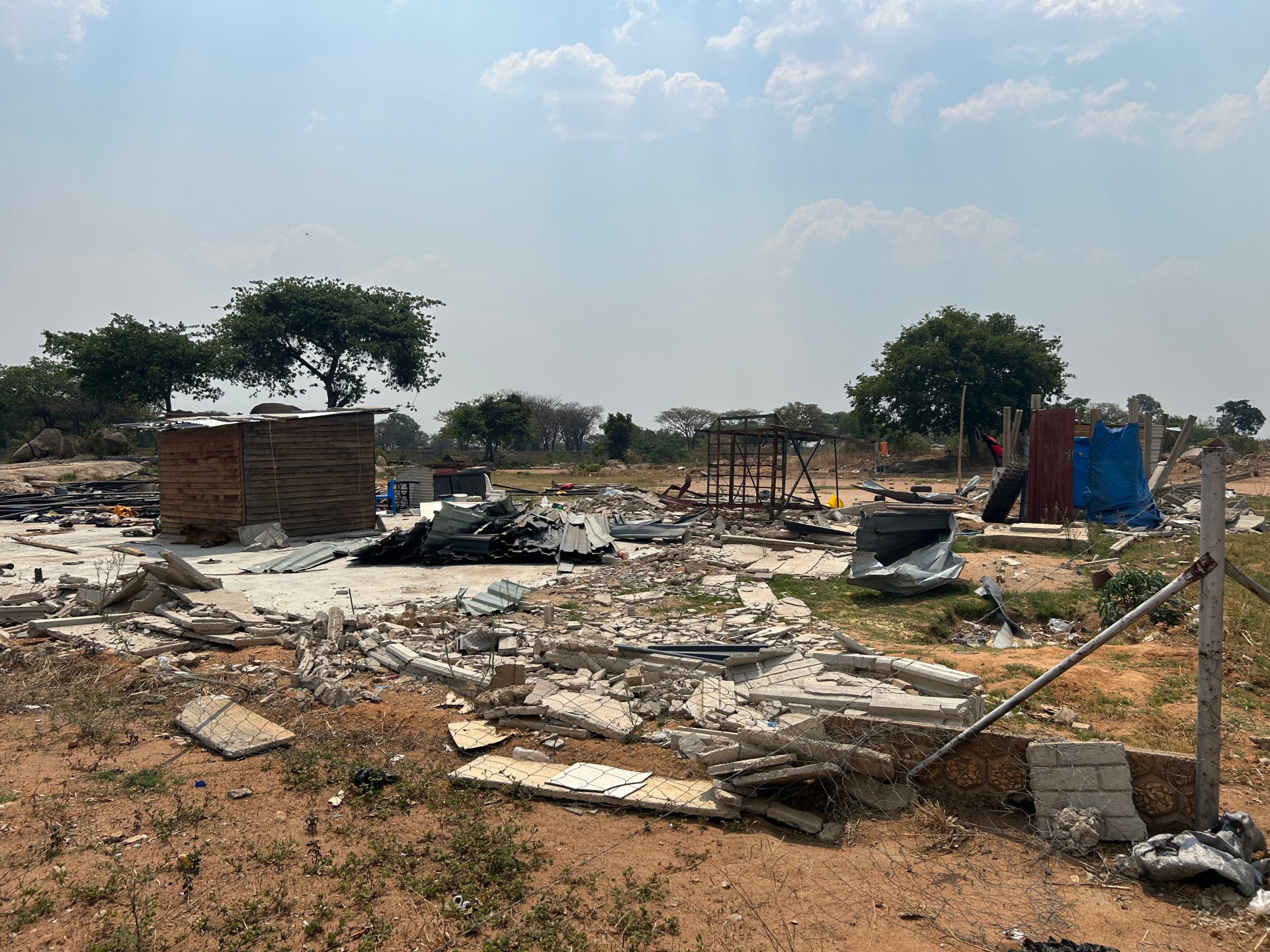

Harare, Zimbabwe – At around 5am on Friday, August 14, Methro Masunga, 28, was jolted awake by the sound of bulldozers and shouting municipal police officers. Outside, earth-moving vehicles were preparing to demolish homes in St Martins Extension, a suburb of Harare.
At first, Masunga thought the machinery had arrived for roadworks. Then she realised her home was among those marked for destruction.
“I thought they were here for some other business, probably land development or road grading; alas, they had been sent to destroy our homes. We tried to understand, but no one would hear us,” Masunga told Al Jazeera.
A single mother of three, Masunga had spent years saving to own a home. She worked part-time cleaning other people’s houses, putting aside what she could to buy a residential stand.
“I worked part-time jobs doing laundry and washing dishes in people’s houses for five years, saving where possible. So, when I came here, I paid the deposit and started monthly contributions,” she said, standing among the remains of her house.
Years of sacrifice reduced to rubble
Masunga began paying for her stand in 2015 and received an allocation in 2019. She says the arrangement was formalised through the city council in 2020, when residents began receiving official documents.
Her experience reflects a wider dispute over land allocations in Harare. Residents say they bought stands through council-linked processes and invested their savings in building homes. The municipality says it is enforcing planning regulations against structures built without the necessary approvals or on land not designated for housing.
Advertisement
The full number of people displaced by demolitions across Harare in 2026 has not been independently established. However, city council records seen by Al Jazeera list more than 5,000 houses facing demolition under 37 outstanding High Court orders. These figures concern properties targeted under the wider programme, not homes already demolished. A council task force has separately inspected 22,255 sites to identify structures on prohibited or unauthorised land.

Authorities say the demolitions are intended to address illegal construction, disputed land sales and development on sites reserved for public infrastructure. Residents argue that enforcement has also affected people who say they obtained allocation letters and agreements of sale through municipal processes.
Memory Chengeta, whose house in St Martins was also demolished, said residents were bewildered by the operation because of an earlier court order.
“There was a court order for them to stop demolitions. The municipal authorities came with no court order that overturned the previous judgement, but went ahead to destroy the properties,” she said.
A former street food vendor, Chengeta had saved to build a more stable life. She is now homeless. Some affected residents have returned to renting, while others, including Chengeta and Masunga, have remained in St Martins, putting up makeshift shelters rather than leaving the area.
Joachim Nhete also lost his home after using his retirement package to buy land and build a house. He estimates his investment at more than $10,000.
The legal question behind the demolitions
The dispute has raised questions about how residents acquired their stands and whether the council complied with existing court orders.
On October 29, 2025, Justice Happias Zhou issued a consent order in case HCH5444/25, setting aside demolition notices issued to named applicants in St Martins Extension. It barred the City of Harare from evicting those applicants or demolishing their homes without a valid court order. It also prohibited further development without written council approval.
The order did not automatically protect every property in St Martins. The available information does not establish whether Masunga, Chengeta or their specific properties were among those covered.
The council has maintained that it did not demolish properties protected by the order. Its spokesperson, Stanley Gama, told local media that the municipality was targeting structures whose owners had repeatedly been warned against building illegally.
Advertisement
“We are only demolishing structures built illegally whose owners were told and warned many times not to proceed with construction,” Gama said.
Harare Mayor Jacob Mafume told NewsDay on August 15 that residents with approved building plans should produce them during council inspections. He said the municipality had repeatedly warned residents to obtain the necessary documents but declined to comment on the legality of the specific demolitions in St Martins.
Harare’s principal housing director, Edgar Dzehonye, later said residents had been warned against building in the area because it had not been adequately serviced.
These explanations raise a separate question: whether residents who received council allocation letters and agreements of sale also had valid planning and building approvals. An allocation to occupy a stand does not necessarily establish that a house was authorised for construction. The status of the residents’ documents, the approved layout, and individual building permits are therefore central to determining whether the demolitions were justified.

Precious Shumba, director of the Harare Residents’ Trust, said the demolitions were particularly troubling because of the court order protecting residents allocated stands by the municipality.
“Despite that, the town planning department and legal officers in the Chamber Secretary’s Department issued directives to the Municipal Police to demolish the houses of St Martins Extension residents,” he said.
Zimbabwe’s Constitution, under Section 74, prohibits the eviction of people from their homes or the demolition of their homes without a court order made after considering all relevant circumstances. The National Human Settlements Policy also calls for alternative accommodation to be prepared before relocations and demolitions. Residents say they were not offered alternative housing.
Residents demand accountability
The controversy reflects long-standing problems in Harare’s land administration. A 2019 commission of inquiry chaired by Justice Tendai Uchena identified unauthorised land sales, weak administration and poor record-keeping by local authorities. It found that land barons had sold state land without authority, sometimes allegedly working alongside council officials.
Shumba said the Harare Residents’ Trust wrote to the president on July 22, 2026, calling for the publication of the report of the commission of inquiry into the financial affairs of the city of Harare. The organisation also wants the findings of the Justice Maphios Cheda commission of inquiry into the city’s governance crisis implemented.
David Jenje, chairman of the St Martins Residents Association and the St Martins Housing Happiness Pay Scheme, said residents had paid for their stands years before receiving allocation letters.
He said the council’s Education, Housing and Community Services Committee resolved in 2019 to expedite the allocation and servicing of the land.
Advertisement
“Most of the members had paid deposits of $5,000 as far back as 2018 … Allocations were made in July 2019 after completion of payment of intrinsic land value. All the allocation letters and agreements of sale were signed in February 2020. These demolitions were illegal,” Jenje said.
ZimRights, a human rights organisation, said the demolitions raised questions about the rule of law and accountability.
Harare South MP Trymore Kanopula called for a halt to further demolitions until the land allocations had been audited and investigated. He also urged the government to present the findings of the commission of inquiry into state land sales to Parliament.
Parliament’s speaker referred the matter to the Ministry of Local Government and Public Works for action.
Minister Daniel Garwe said the government did not carry out demolitions and could not interfere with court processes. He acknowledged that the Harare City Council had approximately 5,000 demolition orders and said the government had sometimes tried to delay demolitions while seeking solutions.
For Nhete, however, official interventions offer little comfort. His house is gone, and he says he has no insurance to recover his investment.
“Unlike some who had home insurance, I didn’t have one,” he said. “I cannot recover the loss and pain. My hope is in the courts of law that Harare City Council must be held accountable and pay us back.”
Related News

NATO says will do ‘anything and everything’ if alliance is attacked

In Israel, Netanyahu’s ultimate legacy is the opposition he has forged

US, South Korea, Japan call for ‘complete denuclearisation’ of North Korea