

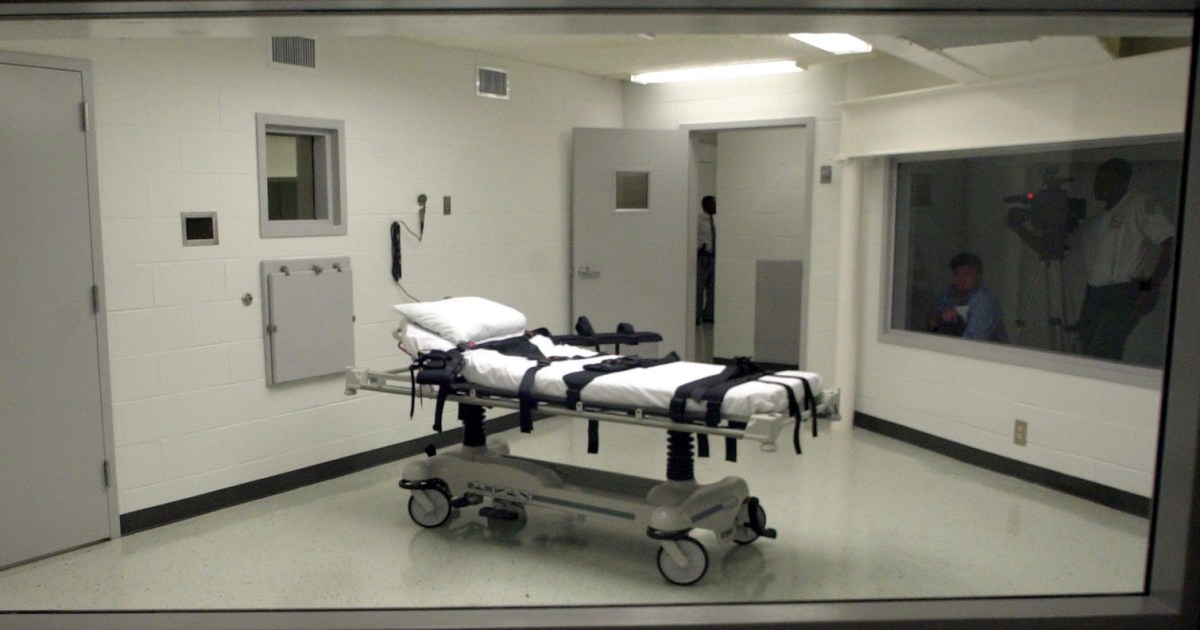

The botched execution of Christa Pike has sparked debate about the death penalty in the United States, where lethal injections, experts say, are frequently marred by mishaps and incompetence.
The attempted execution of Pike, a woman sentenced to death for her participation in the murder of a classmate when she was 18 years old, was called off after two doses of pentobarbital failed to kill her on September 30.
- list 1 of 3Christa Pike was nearly taken off life support before waking, lawyers say
- list 2 of 3Christa Pike is awake after surviving execution: What happens now?
- list 3 of 3Christa Pike lawyers say she is speaking one week after failed execution
end of list
Witnesses reported that she continued to breathe, snore and lift parts of her body off the gurney to which she was strapped even after the lethal injections were administered. Pike’s lawyers said that she had regained consciousness at the hospital on October 6 but faces a long path to recovery.
Governor Bill Lee announced a pause on executions in the state and promised a “comprehensive, third-party review” of the incident, the second case this year in which Tennessee authorities have called off an execution after a failed lethal injection attempt.
The Tennessee Department of Correction declined to comment when asked by Al Jazeera why the execution attempt failed and whether it planned to try to execute Pike again.
While the case has attracted nationwide attention, experts say that botched execution attempts, largely carried out through lethal injection, are a disturbingly common feature of capital punishment in the US.
“This is an opportunity for everyone to stop and really carefully examine all of the ways in which this execution went wrong and to make good decisions about how to move forward, if we’re going to move forward with this method of execution,” said Robin Maher, the executive director of the Death Penalty Information Center, a nonprofit research group based in Washington, DC.
Medical issues
Of the various methods of execution in the US, lethal injection is by far the most common. It is also among the least reliable.
Advertisement
States such as Tennessee, Idaho, Alabama, Arizona, Texas and Oklahoma have all recorded at least one botched execution via lethal injection since 2022, and a survey of executions in the US between 1890 and 2010 found that lethal injections were botched at more than twice the rate of all other methods.
Researchers attribute the poor record of lethal injection to a number of factors, including the difficulty of carrying out what amounts to a medical procedure in a prison setting without access to qualified staff.
Major medical organisations bar members from assisting in executions on the basis that it violates their mandate to do no harm, meaning that prisons rely on staff members or officials with dubious credentials to carry out the procedure.
“Lethal injection has all of the delicacies of a medical procedure: all of the error-prone qualities, all of the need for precision. But it has been warped to fit the needs of execution settings,” said Corinna Barrett Lain, a professor at the University of Richmond School of Law and author of a book on lethal injection.
She explained that she has witnessed botched executions that drag on for hours and include prisoners being punctured with needles more than a dozen times. “It’s this really bad combination of a delicate procedure that is not performed in a delicate way.”
Pharmaceutical companies also restrict the use of their products in executions, meaning that some states acquire drugs used in lethal injection through facilities called compounding pharmacies.
Such pharmacies often prepare medications not manufactured commercially, and the drugs they produce are not as extensively scrutinised as mass-produced medications. Some states have also sought to stretch existing stockpiles of drugs used in lethal injections, though they can become expired or faulty.
The risks are compounded by the people the lethal injections are administered to.
Those on death row often spend years or even decades waiting for their execution. Since many are of an advanced age, they are more likely to have health issues that can further complicate the procedure.
Botched executions often feature failed attempts to locate a vein or set an IV line.
While state officials have yet to offer an explanation of why Pike’s execution failed, her lawyers had previously argued that she had small veins and a blood condition that were likely to complicate a lethal injection effort.
After the lethal injections, Pike’s lawyers described her arms as swollen and burned.
Advertisement
Maher, the head of the Death Penalty Information Center, said those symptoms suggest the injection may not have properly reached her bloodstream.
“Everyone has speculated that the drugs were administered to her but did not enter her bloodstream in sufficient amounts to kill her,” she said. “It’s likely that her veins were blown, or that the needle went through the vein.”
Popular method
When the lethal injection drugs fail to be properly administered, executions can be drawn out and, in some cases, unnecessarily painful for prisoners.
After the first dose of pentobarbital was administered to her, Pike reportedly stated that she felt her arm was “about to burst open”.
In May, Tennessee also called off the execution of Tony Carruthers after staff struggled for more than 90 minutes to establish a backup IV line.
In February 2024, the state of Idaho likewise suspended the execution of Thomas Creech, a man in his 70s, after an execution team failed to properly insert an IV after eight attempts in his arms, legs and feet.
Despite such incidents, lethal injection has become the primary method of execution in 28 of the 29 states that still allow capital punishment, according to the National Conference of State Legislatures. The first execution via lethal injection occurred in Texas in 1982.
According to the Death Penalty Information Center, 39 people were killed by lethal injection in 2025, compared with five by lethal gas and three by firing squad. The last electrocution of a prisoner took place in 2020, and older methods such as hanging have not been employed since the 1990s.
Michael Radelet, a professor of sociology at the University of Colorado who has tracked botched executions, says that lethal injection has taken the place of older forms of execution that came to be seen as outdated and draconian.
Such methods also resulted in grim spectacles that distressed observers. Prisoners being electrocuted sometimes caught on fire or disturbed witnesses with the smell of burning flesh.
“Lethal injection is relatively new, but it’s part of a long-term trend going back hundreds of years in search of a more ‘humane’ method of execution,” Radelet told Al Jazeera.
But he added that the method’s promise of a more peaceful and clinical procedure has been belied by its poor record.
He also pointed to autopsies that show that, despite the relative sterility of the procedure, prisoners still experience pain.
Critics say such information calls into question the widespread use of lethal injection and whether it should be discarded altogether.
“Lethal injection, from the very start, was about a humane-looking execution, not a humane execution,” said Lain, the law professor. “There’s a big difference.”
Related News

Sudan’s al-Burhan rejects talks, vows to retake all territory from RSF

Trump defiant about midterm chances as he rallies for Republicans in Ohio

Israel’s Lapid accuses Netanyahu of ‘fear-mongering’ over attack warning