Bolsonaro favourite to win: What Brazil’s first round of elections tells us
 05 October 2026
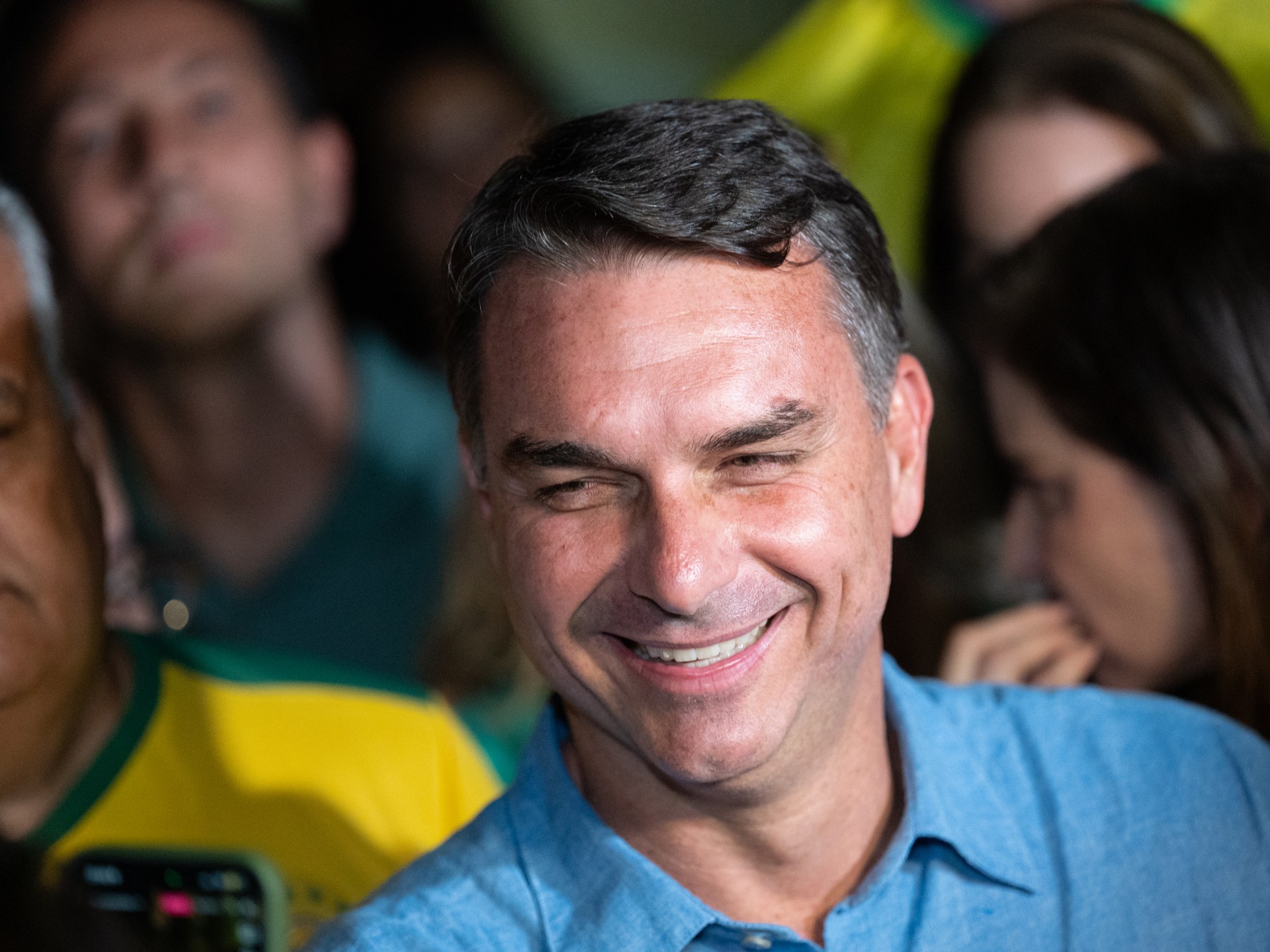

Right-wing Brazilian Senator Flavio Bolsonaro has exceeded expectations in the first-round vote with a slight lead over the incumbent left-wing President Luiz Inacio Lula da Silva, triggering a run-off later this month.
“Brazil wants change, and I am very happy with the results,” Bolsonaro told reporters in Brasilia on Sunday as he saluted “the end of the era of [Lula’s] Workers’ Party”.
- list 1 of 3Brazil’s Lula and Bolsonaro close campaigns ahead of critical election
- list 2 of 3Will Brazil’s Lula halt the right-wing wave sweeping Latin America?
- list 3 of 3Polls close in Brazil’s polarised election pitting Lula against Bolsonaro
end of list
The 45-year-old son of right-wing former President Jair Bolsonaro, who is serving a 27-year jail sentence for plotting a coup after losing the 2022 election, now faces an October 25 showdown with the 80-year-old Lula, who is seeking a fourth nonconsecutive term.
In the run-up to Sunday’s first-round vote, a series of polls showed a close race between Lula and Bolsonaro, with the incumbent president poised to win by about 3 percentage points against his right-wing challenger.
In a surprise result that defied opinion poll projections, Bolsonaro beat Lula with 47 percent of the vote, while Lula got 45.1 percent.
Neither reached the 50 percent threshold needed to win in the first round. That sets up another Lula-Bolsonaro showdown, four years after Lula narrowly defeated Jair Bolsonaro.
Why is Bolsonaro favoured to win Brazil’s election?
Bolsonaro’s stronger-than-expected performance is likely to buoy his campaign and may bolster Brazil’s currency and stock market, which have risen on the prospects of the business-friendly challenger.
Oliver Stuenkel, professor of international relations at the Getulio Vargas Foundation (FGV) in San Paulo, Brazil, said Lula was in a difficult position as he could not count on voters who backed one of the other 10 candidates to vote for him in the second round.
Advertisement
“Not only is he behind now after this first round, but the other candidates who received a total of nearly 8 percent are largely centre-right, which means that the people who voted for these other candidates are very unlikely to shift for Lula,” Stuenkel told Al Jazeera.
“So he must change his campaign tactics and above all mobilise a significant part of people who stayed at home,” he added. About 30 million Brazilians – 21 percent of the electorate – did not vote in the first round.
Al Jazeera’s Monica Yanakiew, reporting from Rio de Janeiro, said Lula supporters felt their candidate had not used social media as effectively as the right-wing camp. “This is something they have to work on in the second round,” Yanakiew said.
From a historical perspective, however, such efforts are unlikely to change the outcome. “Unless something very unusual happens in the next three weeks, Flavio Bolsonaro is set to win,” Stuenkel said. “In Brazilian presidential politics, no candidate who came second in the first round ended up winning the presidency since 1989.”
Has the Bolsonaro family taken hold of Brazil?
Several politicians from the Bolsonaro family have won congressional races taking place as part of the broader nationwide general elections.
Michelle Bolsonaro, wife of former President Jair Bolsonaro and stepmother of Flavio, won a Senate seat in the Federal District, home to the capital, Brasilia.
In June, the 44-year-old, who has never held government office, had a public falling out with her stepson, whom she accused of disrespecting her in lengthy videos posted on her social media. The pair later made up.
Ex-leader Bolsonaro’s second son Carlos Bolsonaro, 43, was the second most-voted senatorial candidate in the southern Santa Catarina state and won a seat in the Senate.
The fourth and younger son, Jair Renan Bolsonaro, was elected to the lower house of Congress.
Some experts credit “antipetismo” — a trend of hostility against Lula’s PT movement — with fuelling the Bolsonaro family’s rise to political power.
Bolsonaro’s Liberal Party (PL) won 121 of the 513 seats in the Chamber of Deputies while Lula’s PT got 70.
What are the implications of a Bolsonaro win?
Brazil’s presidential election carries significant regional and geopolitical implications.
Reporting from Sao Paulo, Al Jazeera’s Lucia Newman said Lula has been “on a collision course” with United States President Donald Trump, who is a vocal and ardent supporter of the Bolsonaro camp.
“That puts Brazil in the middle of a fierce competition between Washington and China for political, diplomatic and economic dominance, especially since Brazil is a powerhouse on all these fronts,” Newman said.
Advertisement
While Bolsonarism is strongly aligned with the US and Israel, Brazil also has a tight economic relationship with China, its largest trade partner. Bolsonaro has portrayed Trump as an ally and is expected to strengthen ties with Washington if elected.
In case of a win, the younger Bolsonaro has pledged to seek a congressional amnesty for his father, who is in prison over his role in a coup plot following his election loss to Lula by 1.8 percentage points in 2022. That would need approval from both houses of Congress, which are currently dominated by conservatives.
Similar to Trump, the Bolsonaros have made rigged election claims. The insurrection that shook Brasilia in January 2023 shared similarities with the storming of the US Capitol two years prior. Like Trump, Bolsonaro has also pledged to release his father’s supporters responsible for the coup.
Concerns about US intervention in Brazil’s domestic affairs have also loomed over the campaign. Lula has accused the Trump administration of using tariffs and other means to interfere with Brazilian affairs.
Vinicius de Carvalho, a lecturer in Brazilian studies at King’s College London, UK, stressed that Latin America has been experiencing a right-wing wave, with the election of US-aligned governments. This includes Ecuador, El Salvador, Panama and Paraguay.
By contrast, Lula was part of the so-called “pink tide” in Latin America, a wave of left-leaning governments that came to power in the late 1990s and early 2000s. With Congress stacked against him, if Lula is re-elected, he will still need to “respond to some demands of the right”, de Carvalho said.
Related News
Iran’s Pezeshkian slams ‘terrorist’ US but extols diplomacy in UN speech

US strikes on alleged drug boats may be ‘crimes against humanity’, UN says
Third person dies from malaria in cluster near Germany’s Frankfurt Airport