


Bologna, Italy – Six minutes and 56 seconds. That is the length of the video capturing the final moments of Abderrahim Fakir, a 42-year-old Moroccan-born man who had lived in Bologna, northern Italy, for more than three decades.
Filmed shortly after 12:30pm local time (10:30 GMT) on Sunday from the balcony of a nearby apartment block, the footage shows two Italian police officers and a civilian restraining Fakir on the ground. He repeatedly screams for help. Four Italian Red Cross volunteers, who arrived with an ambulance, stand nearby.
For more than four minutes, Fakir cries out. Then he falls silent. His ankles are secured with a black plastic zip tie. Only after the restraint ends do paramedics realise Fakir has lost consciousness.
“I ask you to listen very carefully to that video,” says Fabio Anselmo, the lawyer representing Fakir’s family, during a July 21 news conference in the Italian Senate hosted by Senator Ilaria Cucchi.
Cucchi’s brother, Stefano, died in police custody in 2009. Anselmo represented the family during the legal battle that led to the conviction of several officers, making the case a symbol of Italy’s wider struggle over police accountability.
“When the officers stand up, Fakir may still be alive,” Anselmo says. “Yet no one attempts to help him. No one removes the restraints.”
“I have spent almost 30 years dealing with cases like this,” he adds. “The European Court of Human Rights has already condemned Italy.”
Anselmo was referring to a January 2026 ruling by the European Court of Human Rights in the case of Riccardo Magherini, who died in Florence in 2014 after police restrained him face down.
Advertisement
The court found that Italy had violated Article 2 of the European Convention on Human Rights because the authorities had failed to show that maintaining him in that position was “absolutely necessary”.
Hours after Fakir’s death, Bologna police said officers had responded to reports of “a person behaving violently”. They said emergency services had been called immediately and that Fakir died after “restraint procedures” were carried out in the presence of medical personnel.
Prosecutors ordered a post-mortem examination, while Bologna’s local health authority opened an internal investigation.
The footage spread rapidly across social media. Within hours, dozens gathered at the site where Fakir died. Later that afternoon, during a spontaneous vigil, his sister held up a photograph of her brother as she spoke to reporters.
“My brother wasn’t an animal. He was a father, a worker, a good man. Why did they do this to him?” she said through tears. “I want everyone to see his face. I want people to know who he was. We don’t want revenge. We want justice.”
Friends and lawyers who knew Fakir said his final months were marked by fear and financial pressure.
Fear and fallout
Barbara Spinelli, who had represented Fakir on immigration matters for years, told Al Jazeera that he had struggled with severe financial difficulties.
“He started a small removals and logistics business, but after several clients failed to pay for completed work, he was forced to lay off employees and fell into debt,” she said.

According to Spinelli, Fakir had grown increasingly anxious about Italy’s tougher migration debate, including discussions around deportations and the implementation of the European Union’s Pact on Migration and Asylum.
The pact, adopted in 2024 and due to be fully implemented from 2026, introduced new rules on migration management, asylum procedures and returns of people without legal status.
She said Fakir feared he could be expelled from Italy, although there were no legal grounds at the time for such action against him. It remains unclear whether those fears had any connection to the events that led to his encounter with police on July 19.
“I kept reassuring him there were no legal grounds for that to happen,” she told Al Jazeera. “But that fear never left him.”
On the evening of July 20, Bologna Mayor Matteo Lepore called for a solidarity rally in Piazza Maggiore in support of Fakir’s family. Thousands gathered, including trade unionists, students and civil rights organisations.
Advertisement
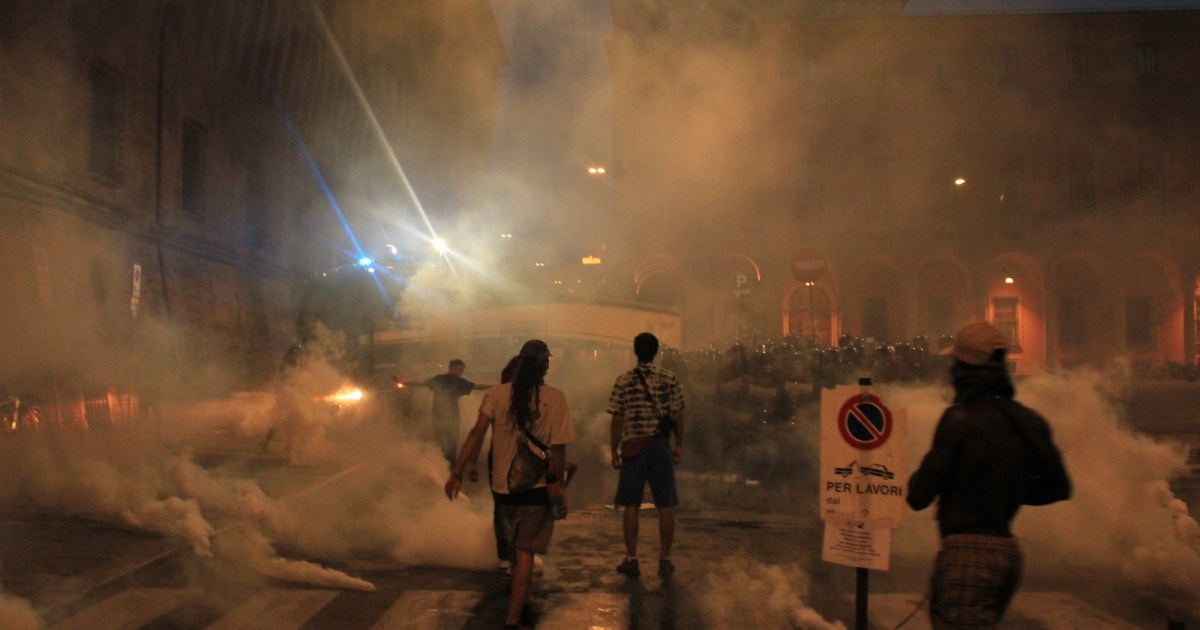
What began as a peaceful demonstration descended into confrontation when part of the crowd marched towards the nearby Prefecture, the local office representing Italy’s central government, and the city’s police headquarters.
Protests turn violent
Clashes broke out after protesters reached a line of riot police.
Demonstrators threw bottles and fireworks, smashed shop windows and cash machines, and set two cars alight. Police used baton charges, water cannon and tear gas.

Several demonstrators later accused the police of using excessive force.
Jacopo, who asked to be identified only by his first name, told Al Jazeera that officers tackled him from behind and threw him to the ground.
“I covered my face with my hands, and they started hitting me with batons and punching me,” he said.
With his hands raised, he said he told officers: “I’m doing what you’re telling me. You’re hurting me.”
“I don’t care. Shut up,” one officer allegedly replied, as the beating continued.
Jacopo was later taken to hospital, where doctors diagnosed multiple bruises and an eye injury.
A freelance journalist working for L’Espresso, an Italian weekly news magazine, told Al Jazeera that officers beat him while he retreated from the clashes.
Video published by the magazine shows him shouting, “I’m a journalist! I’m a journalist!” as an officer repeatedly struck him with a baton. He said the assault ended only after he managed to escape.
Police said 64 officers were injured during the unrest and that Bologna’s historic centre suffered extensive damage.
Political reckoning
Prime Minister Giorgia Meloni condemned the violence, calling the clashes “unacceptable”. She said Fakir’s death “must be fully established, without prejudice and without discounts for anyone”, while adding that “nothing can justify violence against law enforcement officers”.
![A protester gestures with a raised hand as police officers stand nearby during a demonstration in Bologna following Fakir’s death [Dea Sibilla/Al Jazeera]](https://www.aljazeera.com/wp-content/uploads/2026/07/Lorenzo-Pasini-7-1784749083.jpg?w=770&resize=770%2C513&quality=80)
Opposition parties called on Interior Minister Matteo Piantedosi to report to parliament on the circumstances surrounding Fakir’s death and release any body-camera footage recorded by the officers involved.
A test of accountability
The investigation will be the first conducted under Italy’s new Article 45-bis procedure, introduced by the Meloni government’s Security Decree, which came into force in February 2026.
Under the procedure, police officers are not immediately entered into the register of criminal suspects when alleged offences are committed in the course of their duties. Opposition parties, legal scholars and human rights organisations say the change could make it harder to hold officers to account.
![People, including family members, hold pictures of Abderrahim Fakir during a vigil in Bologna after his death during a police restraint [Dea Sibilla/Al Jazeera]](https://www.aljazeera.com/wp-content/uploads/2026/07/Dea-Sibilla-2-1784749117.jpeg?w=770&resize=770%2C513&quality=80)
Anselmo called the reform “a legal monstrosity”.
Advertisement
“It wasn’t designed to strengthen the rule of law,” he said. “It was designed to satisfy part of public opinion.”
Related News
Tuchel: England carry ‘scars’ of World Cup heartbreak into France playoff
Sons of Iran’s leader Ali Khamenei attend funeral, but Mojtaba is absent
Guyana reports ferry disaster death toll rises to 41