

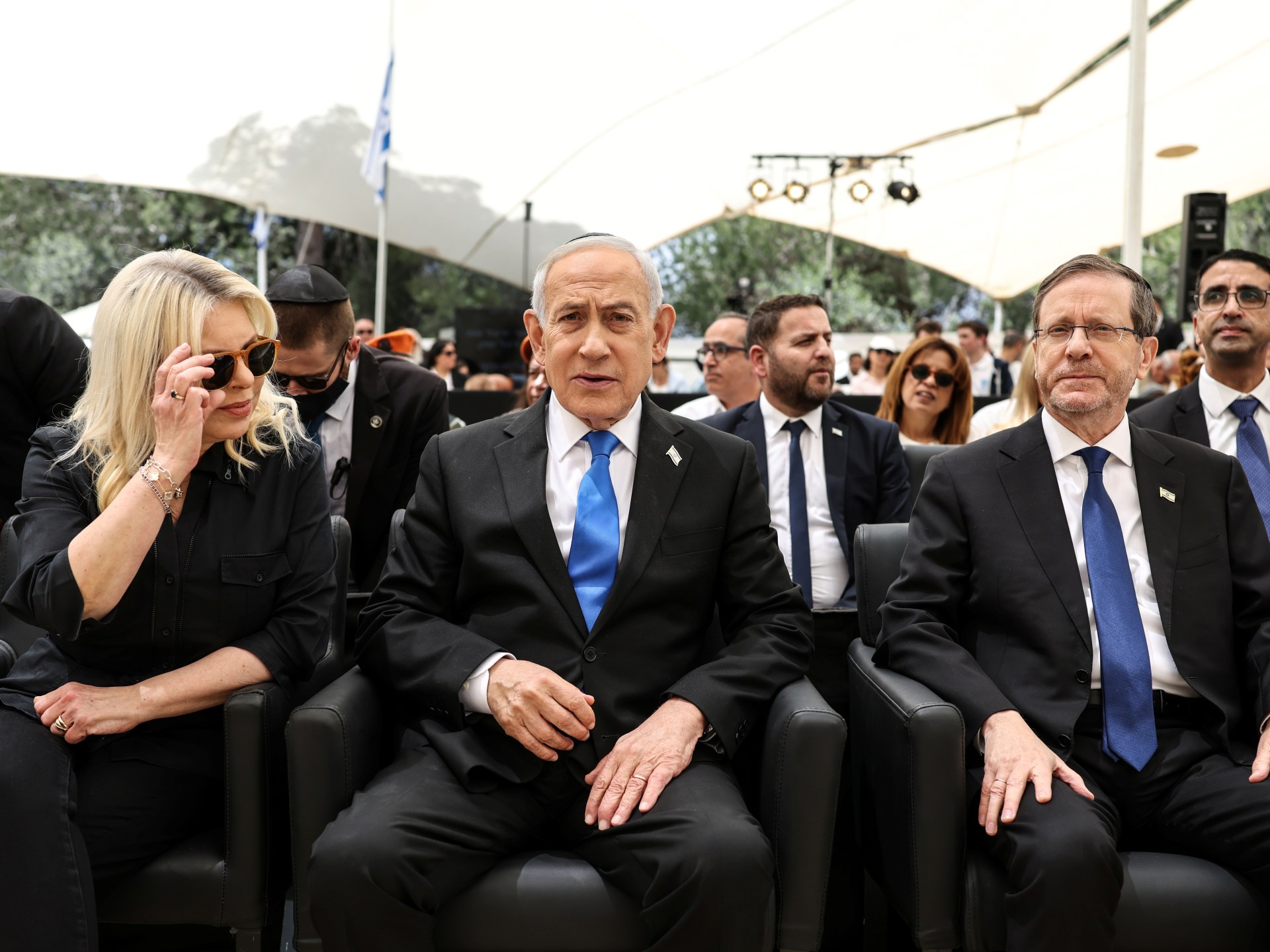

Upcoming elections in Israel will likely decide the legacy of Prime Minister Benjamin Netanyahu, who faces mounting pressure over his handling of wars in the region and corruption charges.
Netanyahu, Israel’s longest-serving prime minister, is regarded as the ultimate survivor in Israeli politics. But with the upcoming general election, slated for October, he is now confronted with his biggest challenge yet that could see his nearly four-decade political career come to an acrimonious end.
- list 1 of 4Pragmatic choice: Israel’s war backfires as Gulf backs US-Iran deal
- list 2 of 4Forever wars: Israel’s cycle of conflict shows no finish line
- list 3 of 4Who has profited most from the war on Iran?
- list 4 of 4IAEA demands verification of Iran nuclear ambitions amid ‘statement war’
end of list
In the background is a torrent of political events, after Netanyahu reportedly convinced United States President Donald Trump to join him in a war on Iran on February 28, causing Tehran to launch its own strikes on Israel, the Gulf states and shipping in the Strait of Hormuz.
Israel is embroiled in another war with the Lebanese armed group Hezbollah to the north. This has seen Netanyahu trapped between US pressure to halt the military offensive in Lebanon and an Israeli public eager to continue the fight against Iran and its regional proxies.
Meanwhile, Netanyahu also faces widespread public anger over his failure to hold an independent public inquiry into his government’s failings before and after the Hamas-led attacks into southern Israel on October 7, 2023.
Following its subsequent genocidal war in Gaza, Israel has faced growing international scrutiny over its actions, sliding into pariah status with some countries and more vocal criticism within the US political establishment.
All the while, Netanyahu still faces multiple corruption charges dating back to 2019, and if found guilty of these, he could potentially end up behind bars.
Advertisement
Ultimately, the Israeli election comes at one of the most critical moments for Netanyahu and the country.
“It looks like [Netanyahu] might be in real trouble,” political analyst Nimrod Flaschenberg told Al Jazeera. “The US agreement with Iran hasn’t been well received, and to the public, it’s really not clear what’s happening in Lebanon.
“Nobody knows if it’s a ceasefire, a retreat or whatever, and the press here are very suspicious. Lastly, there’s the issue of the US. Israelis have long liked to think they can operate autonomously, but recent events have really shown that to be a fiction.”
Rock or hard place
The Israeli public is acutely aware of the importance of US backing for their country’s security. Now, Israel and the US appear to find themselves with very different opinions on the future of the war in Lebanon, with Trump eager to scale back the fighting so peace with Iran holds and shipping can return to normal in the Strait of Hormuz.
Iran has ensured that Lebanon is part of the agreement to end the war with the US, so any new Israeli assaults in southern Lebanon threaten the stability of the memorandum of understanding between Tehran and Washington.
Netanyahu is being blamed by both doves and hawks in Israel for the military campaign in Lebanon, with right-wingers urging him to continue the war and defeat Hezbollah, a difficult task given the resistance provided by the armed group and US pressure. Others are aware that defying Trump’s wishes will put further pressure on US-Israeli relations.
Israel still illegally occupies around a fifth of Lebanon, and a framework agreement signed with Beirut in Washington on Friday makes its future military presence in the country uncertain. Almost three-quarters of Israelis have said they backed Israel’s continued occupation of Lebanon, while just over one in 10 oppose it, a recent poll suggests.

Gadi Eisenkot – a former Israeli army chief of staff and Netanyahu’s current main political challenger – blamed the current US-Israel spat on Netanyahu’s inability to articulate to Washington his country’s strategy in Lebanon.
“We failed to capitalise on our military achievements and woke up to a security reality that must not be allowed,” Eisenkot told a Hebrew-language podcast of Israel’s stalled invasion. “Even the fact that Israel needs approval from Washington in order to carry out a strike in Lebanon is inconceivable.”
Advertisement
“Much of the opposition are outflanking him from the right with claims that they have their own magical military or diplomatic solutions to what’s happening in Lebanon,” former Israeli government adviser Daniel Levy said, “[and ] all the while Netanyahu will play for time and actively work to undermine the deal between the US and Iran.”
US relations
Under the terms of the memorandum of understanding signed by Iran and the US on June 18, both sides and their allies commit to the “immediate and permanent termination of military operations on all fronts, including in Lebanon”. Perhaps most critically for Netanyahu, it states that both countries guarantee the “territorial integrity and sovereignty of Lebanon”.
Despite this, Israel has publicly refused to commit to withdrawing from Lebanon’s territory and has continued to attack it, with about 4,230 people killed and another 12,179 wounded in the latest conflict since March 2. Meanwhile, northern Israeli towns remain within range of Hezbollah rockets and drones, with the Lebanese armed group far from being defeated.
“Netanyahu promised people living in northern Israel a future he couldn’t possibly deliver,” political analyst Ori Goldberg said.
“He promised them a morning when they could wake up, look out of their window and never have to see an Arab, but I’m not sure people really believed that, or thought it could happen. People are tired, they’re craving some kind of normalcy, whatever that is. So, there may be room for Netanyahu to manoeuvre on Lebanon and get away with it.”
This window for Israel to continue to operate in Lebanon could be short, however. According to media reports, Trump is growing tired of Netanyahu’s actions in Lebanon and elsewhere, describing the Israeli PM as “crazy” in one phone call.
On June 7, Trump told The Financial Times that Netanyahu must abide by Washington’s ceasefire agreement with Iran, insisting, “I call all the shots. He doesn’t call the shots.”
Levy, the former Israeli government adviser, noted that while Trump and Netanyahu have held seven face-to-face meetings during the US president’s first 13 months in office, they have had none since embarking on the war on Iran together on February 28, 2026.
“That’s going to worry Netanyahu. Right now, he’s probably angling for another meeting … he has to be thinking what he can do to win the US president back and do so before the elections,” Levy told Al Jazeera.
“Ultimately, Netanyahu’s watching the minute hand and avoiding the hour hand; time is that tight.”
Related News
Wildfires still burning in France and Spain amid fears of more to come
Trump’s attorney general pick faces possible Republican roadblock
US or Iran — Who needs a new truce deal more?