

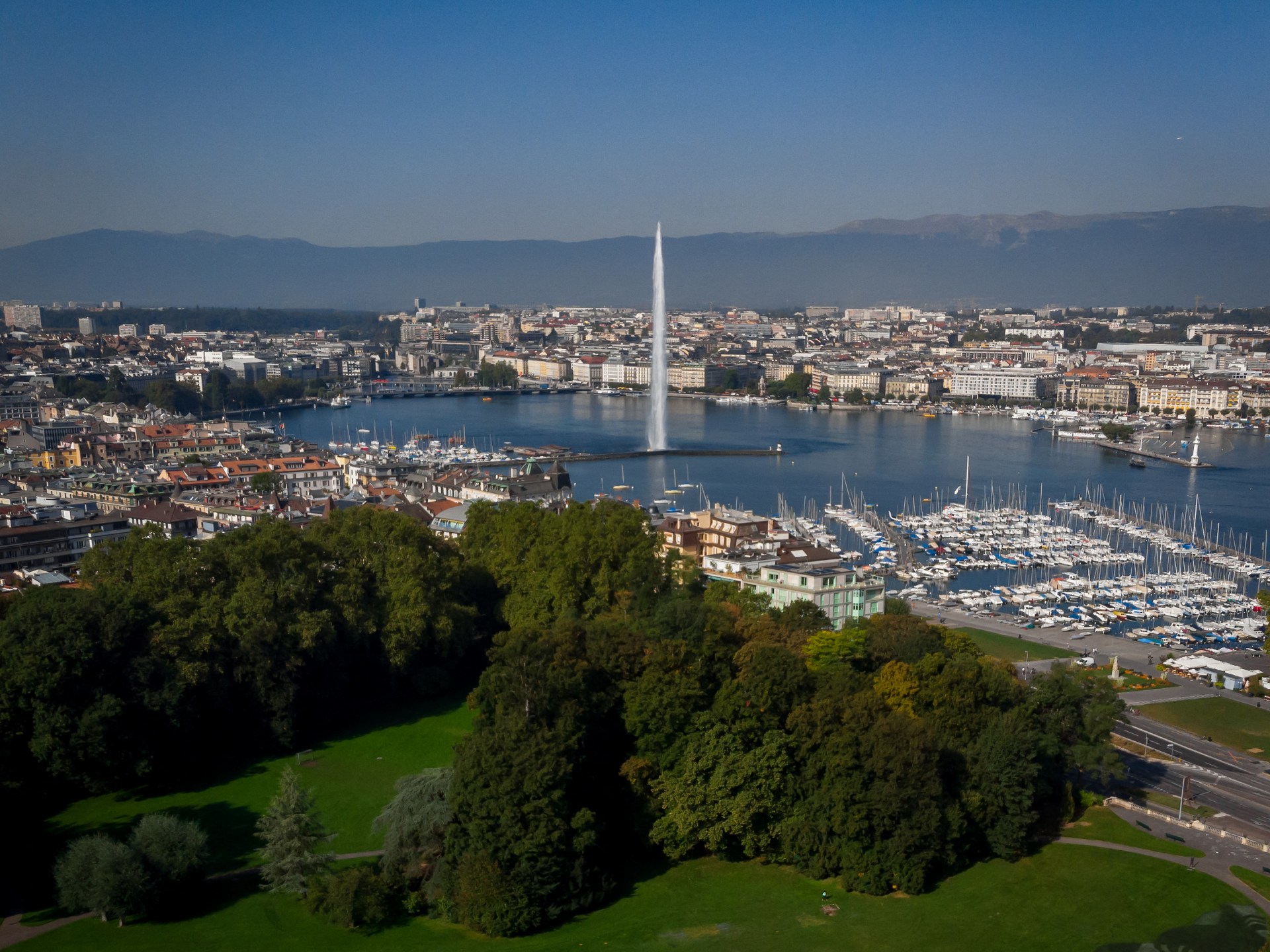

The United States and Iran are to sign a memorandum of understanding (MoU), ending weeks of war and starting 60 days of negotiations, in the Swiss city of Geneva on Friday.
The event will be hosted by Pakistan, which has played a key role in mediating between the two adversaries since the war began with US-Israeli strikes on Tehran on February 28.
- list 1 of 3Trump says ships ‘starting to move’ through Strait of Hormuz
- list 2 of 3Is Lebanon included? Country hopeful for US-Iran ceasefire, despite doubts
- list 3 of 3Netanyahu says Israel won’t leave occupied land in Lebanon
end of list
While it is still unclear which officials will represent the two warring parties and the mediator in Geneva at the ceremony, the location of the event is significant.
Geneva, often called the “Peace Capital” of the world, has acted as a hub for international diplomatic efforts and has hosted the signing of several peace treaties.
Ian Lesser, distinguished fellow at the German Marshall Fund of the United States, told Al Jazeera that several other factors are also at play in the choice of Geneva for the signing of this particular agreement.
“Swiss neutrality, the presence of United Nations and multinational agencies and a range of suitable, discreet venues in Geneva make it an ideal location for such deals,” he said.
“It is also a very practical place logistically,” he added.
What are some of the other peace agreements that have been signed in Geneva?
Geneva Conventions
The original Geneva Convention, which established international rules for the treatment of sick and wounded soldiers, was held on August 22, 1864. It was initiated by Swiss businessman Henry Dunant and drafted by the International Committee of the Red Cross (ICRC) after the 1859 Battle of Solferino, also called the Second Italian War of Independence.
Advertisement
In 1949, shortly after World War II, 63 nations expanded these rules, seeking to limit the horrors of war, and signed new Geneva Conventions on August 12 that year. These conventions are four international treaties that, together with additional protocols, now form the basis of international humanitarian law.
The first of these is the Geneva Convention (I) for the Amelioration of the Condition of the Wounded and Sick in Armed Forces in the Field. According to the ICRC, this convention provides “protection for the wounded and sick, but also for medical and religious personnel, medical units and medical transports”. The convention also contains essential protections “for the populations of occupied territory”, ensuring their human rights are protected.
The second is the Geneva Convention (II) for the Amelioration of the Condition of Wounded, Sick and Shipwrecked Members of Armed Forces at Sea. According to the ICRC, this convention calls for “the protection of wounded, sick and shipwrecked members of armed forces at sea” and its articles also provide “specific protection for hospital ships, coastal rescue craft, medical aircraft and other medical transports at sea, as well as religious, medical and hospital personnel performing their duties in a naval context”.
The third treaty is the Geneva Convention (III) on the Treatment of Prisoners of War. According to the ICRC, this convention “establishes the principle that prisoners of war must be released and repatriated without delay after the cessation of active hostilities”.
The fourth treaty is the Geneva Convention (IV) on the Protection of Civilian Persons in Time of War. According to the ICRC, this convention “protects civilians across all situations of international armed conflict, that is, armed conflict between two or more States, including situations of occupation”. It also covers noninternational armed conflict.
Geneva Accords (1954)
These are a series of agreements that provided the framework for ending hostilities in the First Indochina War, which was fought from December 1946 to August 1954 between France and the Viet Minh, or League for Independence of Vietnam. and their allies.
The accords were signed in Geneva on July 20-21, 1954, by representatives of Cambodia, Laos, France, the United Kingdom, US, Soviet Union, China, what became known as North Vietnam and South Vietnam, and other involved parties. While the accords helped to end French colonial rule in Indochina and granted independence to Vietnam, Laos and Cambodia, it temporarily divided Vietnam at the 17th parallel into two zones: the communist-led Democratic Republic of Vietnam (North Vietnam) and the French-backed State of Vietnam (South Vietnam). The accords called for Vietnam reunification elections in July 1956.
Advertisement
Israel-Syria Disengagement Accord
Signed on May 31, 1974, this agreement was brokered by the US between Israel and Syria and brought an end to hostilities between the two countries after the 1973 Yom Kippur War. In October 1973, Egypt and Syria attacked Israeli forces in the Sinai and Golan Heights on Yom Kippur, the Jewish day of atonement, hoping to reclaim territory lost in the Six-Day War of 1967. They made initial gains but were later forced to retreat during an Israeli counterattack.
While this agreement is not a considered a peace treaty, it is a key disengagement pact that “establishes a zone of separation [between Israel and Syria], calls for the disengagement of forces and the release of prisoners of war”.
“Israel and Syria will scrupulously observe the cease-fire on land, sea and air and will refrain from all military actions against each other, from the time of the signing of the document, in implementation of United Nations Security Council resolution 338 dated October 22, 1973,” the agreement states.
The agreement also provided for a buffer zone in which the UN Disengagement Observer Force was stationed to maintain peace between the two militaries.
Egypt-Israel Accord
Also known as the Sinai II Agreement, this accord, mediated by then-US Secretary of State Henry Kissinger, was an interim disengagement pact signed on September 4, 1975, in Geneva between Egypt and Israel.
According to US government archives, the agreement “constituted a first step towards a just and durable peace” after the Yom Kippur War.
Under this agreement, Israel and Egypt agreed “not to resort to the threat or use of force or military blockade against each other” and also to “continue scrupulously to observe the ceasefire on land, sea and air and to refrain from all military or para-military actions against each other”.
According to the UN, under the agreement, Israel also agreed to “withdrawal in Sinai to the eastern ends of the Mitla and Gidi Passes”. The agreement called for the “creation of a UN-monitored buffer zone in the evacuated area, turning of the previous buffer zone into Egyptian territories and Israeli withdrawal from the oil fields at Abu Rudeis and Ras Sudar”.
The two nations also agreed “to open the Suez Canal to Israeli non-military cargo ships and to establish American early-warning stations in the area of the passes”, the UN noted.
Geneva Accords (1988)
These accords are a series of UN-brokered agreements signed on April 14, 1988, by Afghanistan and Pakistan with the Soviet Union and the US as guarantors to end the Soviet Union’s war on Afghanistan.
These agreements led to the withdrawal of Soviet troops from Afghanistan and called for the voluntary return of Afghan people who had fled during the war.
Geneva Accord (1991)
In November 1991, Croatia, Serbia and the former Yugoslavia signed a ceasefire commonly called the Vance Plan, negotiated by then-US Secretary of State Cyrus Vance, to end the Croatian War of Independence between Croat forces, the Serb-controlled Yugoslav People’s Army (JNA) and local Serb forces.
Advertisement
According to the UN, this agreement called for “an immediate cessation of hostilities, the lifting of Croatia’s blockade of Yugoslav army barracks and for the withdrawal of JNA forces from Croatia”.
Geneva Accord (2003)
Officially known as the Geneva Initiative, this accord is a draft agreement for a two-state solution to end the conflict between Israel and Palestine. The proposal was drafted by Israeli and Palestinian officials, supported by the Swiss government in October 2003 and officially launched in December 2003.
Some of the main points of the peace plan include waiving the right of return for Palestinian refugees who were forced out in previous wars between Israel and Palestine; dividing Jerusalem and giving Palestinian Muslims control over the Al-Aqsa Mosque site; establishing Jewish control over the compound’s al-Buraq wall, referred to by Jews as the Western Wall; making Jerusalem the capital of both a Palestinian and an Israeli state; annexing to Israel all Jewish settlements built in the illegally expanded boundaries of Jerusalem since 1967, where about 200,000 settlers lived; and removing most Jewish settlements in the rest of the occupied West Bank and Gaza Strip.
The initiative, however, was not officially adopted by either Israel or Palestine.
Related News
Trump directs interim US intelligence chief Bill Pulte to downsize agency
Iran announces funeral, burial dates for late Supreme Leader Khamenei
Israel kills 14 in southern Lebanon after trading fire with Iran