

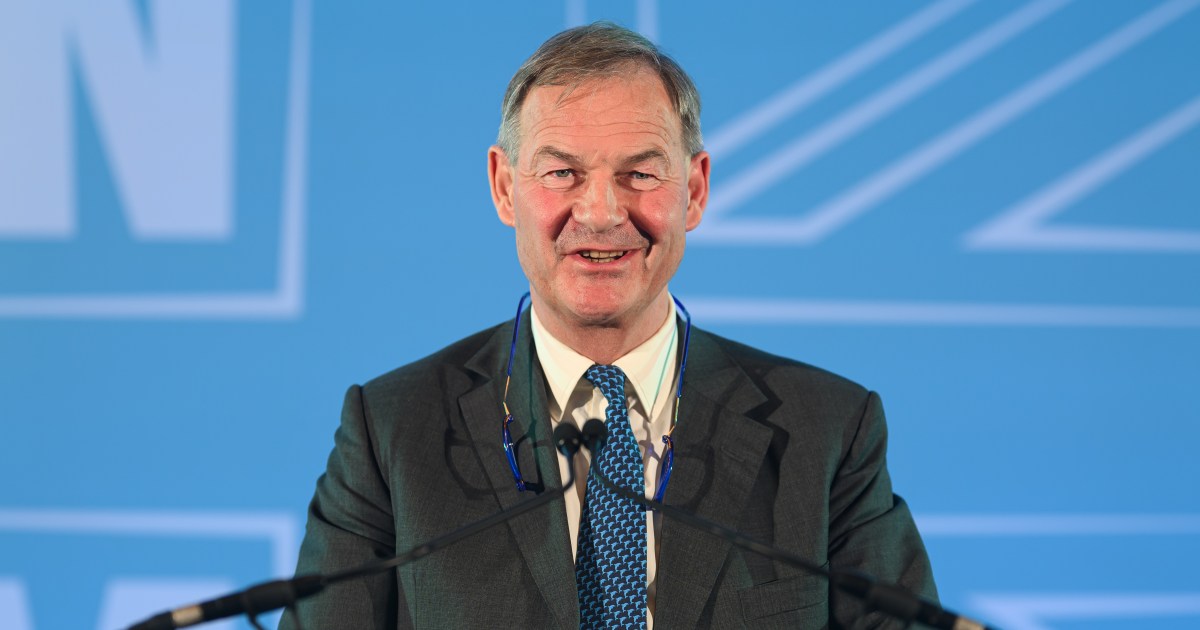

When Nigel Farage, leader of the far-right, anti-immigration party Reform UK, addressed the nation while bizarrely standing in a field this week, he was a man on a mission.
“It is time to respond with pure cold rage,” he pronounced.
- list 1 of 3‘Supercharged’ donations: How far-right Reform UK built a global network
- list 2 of 3UK elections – early results and takeaways; will Starmer have to resign?
- list 3 of 3‘Leader of the pack’: Reform UK makes huge election gains in blow to Labour
end of list
Farage was speaking about the fatal stabbing of a white teenage boy, Henry Nowak, in December 2025 by a Sikh man armed with a ceremonial knife. When police arrived at the scene, instead of arresting the attacker, they took his (false) word that Novak had racially abused him and refused to believe the 18-year-old when he told them he had been stabbed.
Footage from the incident – which Novak’s family have allowed to be released to the public – shows a devastating scene in which the dying boy is handcuffed, uttering his last words, “I can’t breathe.”
Many politicians have since leapt on the opportunity to reap political capital from the tragedy. “I just kept thinking, that’s someone’s boy. That could be my boy,” Kemi Badenoch, leader of the former governing – now floundering – Conservative Party, told The Times newspaper on Tuesday.
Farage seized the chance to rally Reform supporters against what he has framed as an appalling example of extreme racism towards a white boy – even going so far as to liken the tragedy to the killing of George Floyd by a police officer in the US.
But his real message, observers say, was to former supporters who have deserted his party in droves in favour of a new far-right group, Restore Britain, which is arguably even more anti-immigration than Farage himself. Since its launch less than four months ago by disgruntled former Reform member Rupert Lowe, Restore has amassed more than 96,000 members and 13 councillors who have mostly defected from Reform.
Advertisement
Splintering the far right
As a single parliamentary seat in the north of England prepares for a critical by-election that could ultimately determine the United Kingdom’s next prime minister later this month, the far right is preparing to do its own battle for the constituency.
In Makerfield, Greater Manchester, a by-election is expected to take place on June 18, following the departure of current Labour MP Josh Simons to make way for Manchester Mayor Andy Burnham to contest the seat. If he is successful, Burnham will re-enter Westminster after an absence of nine years to stand for the leadership of the party against Prime Minister Keir Starmer, who has been badly damaged by disastrous local election results last month. Burnham was last an MP for the constituency of Leigh until May 2017. Since that year, he has served as mayor of Manchester.
Getting back into Parliament won’t be a walk in the park for Burnham. Labour, which has held the seat in Makerfield since 1983, can expect stiff competition from Farage’s increasingly popular Reform UK, which came second in Makerfield in the general election in 2024. Indeed, an opinion poll by Survation last week put Burnham only slightly ahead of Reform UK’s candidate, Robert Kenyon, with 43 percent and 40 percent, respectively.
But that poll also found that Reform’s share has been dented in a small but significant way by newcomer Restore, whose candidate, Rebecca Shepherd, is polling at 7 percent in her party’s first parliamentary contest.
The creation of a new party that splinters the far-right, anti-immigration vote may seem counterintuitive, but Georgios Samaras, assistant professor of public policy at the School for Government and the Policy Institute at King’s College London, told Al Jazeera that it’s not actually all that surprising, as Reform UK is increasingly seen as “mainstreaming” its ideas as it attempts to make itself more palatable to the population at large.
“Reform in the eyes of far-right extremists is too soft,” Samaras said. A gap in the market has emerged, and it has been filled by Restore, led by Lowe, MP for Great Yarmouth and a former member of Reform.
“They [Restore] know that a percentage of Reform is openly fascist, and they are trying to attract that audience. I don’t know how serious the damage is going to be, but Rupert Lowe seems to be filling a gap that will further demonstrate that the far right has become quite powerful,” he said.
“In my view, Rupert Lowe and Restore Britain are the expressions of neo-Nazism in this country, and that audience requires a politician to express those ideas. Rupert Lowe is that man,” Samaras said.
Advertisement
“Their narratives don’t have to involve Nazi symbolism; they can support Nazi ideas without being openly, symbolically, and stylistically Nazi,” he added.
Immigration, immigration, immigration
Lowe is now positioning himself as the only leader willing to take truly decisive action against immigration and he is attracting attention. On Monday this week, tech billionaire and owner of SpaceX, Elon Musk, publicly endorsed him. “Only Restore Britain can save Britain,” he declared on X.
Musk retweeted a post by Lowe himself, who claimed that had tried to “put me in prison because I backed the mass deportation of Pakistani child rapists and their foreign wives/relatives who allowed it to happen”.
This is an apparent reference to a grooming gangs scandal, which has been rumbling in the UK for a few years.
“I founded Restore Britain to give the British people the democratic option to agree with me. Restore Britain will, without apology, deport every last foreign rapist and all foreign accomplices who knew it was happening, yet failed to act,” he said.
“Now, Reform are incandescently angry that we are giving the British people that choice. Deploying increasingly desperate smears against our movement,” Lowe added.
As part of Restore Britain’s manifesto, the party has stated that it would implement the “most ambitious programme of mass deportations ever seen in Britain”, which would include deporting legal foreign-born migrants if they claim benefits or are unable to speak English.
The party also adheres to the far-right, “Great Replacement” conspiracy theory, which claims that “native” British people will be outnumbered by “non-native” citizens within a few decades.
“Native British births will account for fewer than 50 percent of total births in Britain” by 2030, the party has stated. It has also claimed that, by 2070, “native Brits will be an absolute minority.”
‘Britain first’
Alongside Restore Britain’s big plans for immigration, the party’s manifesto states it will “put British interests first”, including “ending all forms of foreign aid that do nothing to advance Britain’s national interests in the world”.
It adds that the party will end Diversity, Equity and Inclusion directives in the British Armed Forces and “make Britain safe again” by implementing widespread stop-and-search powers for the police. In terms of economic policy, the party states that it would rebuild the country’s industries and infrastructure and repeal net-zero goals. Like Reform, however, there are scant details about how all this will be paid for.
Nevertheless, Samaras says there is an appetite for it in the UK due to rising socioeconomic deprivation, which the far right has squarely blamed on immigration. Remove the immigrants, they say, and free up all the money they are costing the country.
“I think that a lot of Brits who are willing to vote for Reform or Restore, in this case, have no understanding of how migration works and they have no understanding of the costs of migration, so it’s very easy to demonise migrants, scapegoat migrants,” he said.
Advertisement
“How many people actually receive benefits who are legally resident foreign nationals? How many of them cannot speak English, and how many of them refuse to work? These are Restore Britain’s claims. The percentage is tiny. It’s incredibly tiny, but people don’t know that. So, their appetite derives from vibes and political claims from two dangerous entities that are trying to politicise migration,” he added.
A cycle that ‘cannot be broken’
A new era of multi-party politics and a growing appetite for hardline, anti-immigration and Islamophobic views are driving the rise of the far right in the UK, experts say.
“There is a market out there for some pretty extreme issue-stances on migration and multiculturalism – one that Reform UK might find difficult to cater to if it also wants to attract more moderate (albeit anti-immigration and sometimes Islamophobic) voters,” Tim Bale, professor of politics at Queen Mary University of London, told Al Jazeera.
Moreover, Samaras added, the way Muslims in the UK are currently being scapegoated is “unprecedented in European standards”.
According to Tell MAMA, which measures anti-Muslim attacks across England, 6,313 cases of anti-Muslim hate were recorded in 2024, the highest number recorded since the founding of the project in 2011/2012. It amounted to a rise of 165 percent of verified cases reported since 2022.
In reality, this rise in public anger towards immigrants and Muslims is taking place alongside a drop in immigration, Samaras pointed out.
The Office for National Statistics (ONS) reported last week that net migration fell to 171,000 in the 12 months to the end of December from 331,000 a year earlier, continuing a sharp decline from 2026.
“It’s a cycle that cannot be broken unless politicians stop talking about other people’s religions and focus on the economy. The idea of Islamic terrorism in this country, there is an obsession of the British population with Islam … its xenophobia and Islamophobia that have emerged during times of socioeconomic deprivation,” he added.
Ultimately, it may take the far right to defeat the far right in the UK.
The rift between the leaders of Reform UK and Restore Britain has been brewing ever since Lowe, when still a member of Farage’s Reform UK, had the party whip suspended due to bullying and harassment complaints last year – claims that Lowe denied.
On Sunday, Farage told The Telegraph newspaper that Musk was seeking to split the right wing in British politics and was “supporting a party that’s one man with a social media account”.
“Quite what he’s trying to achieve, I have no idea,” he said, adding that Burnham would be “delighted” by Musk’s efforts.
But experts like Bale say Restore shouldn’t be dismissed so easily, that, with anger and frustration towards the government over immigration riding high among the public, a party like Restore Britain “might have a future”.
“At least as a party that could pick up a few seats here or there wherever those voters are concentrated,” he added.
“More importantly, it could – as it might do in Makerfield – snatch a few votes that might otherwise go to Reform, making it more difficult for Farage’s outfit to form a government after the next election, even if it emerges, as looks possible right now, as the largest party in parliament.”
Related News

Iran war live: US bombs Qeshm, Goruk; Kuwait reports missile, drone attacks

US to designate two Brazilian gangs as ‘terrorist’ organisations

Dozens killed in blast at explosives depot in northeastern Myanmar