

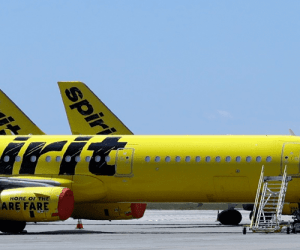


News Americas, NEW YORK, NY, Mon. May 4, 2026: For years, Spirit Airlines was the punchline of airline jokes. It was the airline people warned you about. The one that came with disclaimers. The one where comfort was optional, legroom was negotiable, and expectations had to be managed long before boarding even began.
And yet, for many, it was something far more important. It was access; it was possibility. It was the difference between going home and staying away.
Now, with news surrounding its dissolution following its failed merger efforts with JetBlue Airways, Spirit Airlines is quietly exiting the skies. While some travelers celebrate what they see as the end of a frustrating flying experience, others, particularly within Caribbean communities, are left reflecting on what its absence truly means.
Because for all its flaws, Spirit Airlines served a purpose that many larger carriers either overlooked or priced out of reach.
In 2009, I found myself in a position that many in the Caribbean diaspora know all too well.
A loss in the family.
A sudden need to return home.
A financial reality that did not care about grief.
I had just left college. Money was tight. Responsibilities were not. Flying from New York back to Jamaica was not a luxury. It was a necessity. Like many others in similar situations, cost became the defining factor in whether that journey could even happen.
That is when I found Spirit Airlines.
There were warnings, of course. People told me what to expect, or rather, what not to expect. Comfort was not guaranteed. Space would be limited. The experience, they said, might test my patience.
They were right.
At six feet tall, sitting nearly upright with minimal legroom was not ideal. But none of that mattered in that moment. I was not looking for comfort. I was looking for a way home.
And Spirit gave me that.
The flight attendants were courteous. The process was straightforward. The plane did exactly what it needed to do. It got me from point A to point B safely.
Sometimes, that is all that matters.
For many travelers, especially those from the Caribbean, Spirit Airlines was never about luxury. It was about practicality.
It was about being able to attend a funeral without going into debt.
It was about visiting family during the holidays without sacrificing rent.
It was about maintaining cultural and familial ties across borders in a way that was financially sustainable.
For vacationers, it offered something equally important. Travelers could save on airfare and redirect those funds toward experiences, local businesses, and time spent on the ground rather than in the air.
In this way, Spirit Airlines quietly democratized travel.
It made movement accessible.
And in doing so, it became part of the lives of people who may never have publicly defended it, but relied on it, nonetheless.
To be clear, Spirit Airlines earned much of its criticism.
Its business model, based on unbundled fares and additional fees for carry-ons, seat selection, and even basic comforts, frustrated many passengers. Delays, cancellations, and customer service issues often amplified those frustrations.
For some, the airline represented everything wrong with modern air travel.
And yet, that same model is precisely what allowed it to offer some of the lowest base fares in the industry.
It was not designed to be loved.
It was designed to be affordable.
And for a specific segment of travelers, that trade-off was not only acceptable. It was necessary.
The disappearance of Spirit Airlines does more than remove an option from travel websites.
It creates a vacuum, a gap in the market that will not easily be filled.
Low-cost carriers operate on thin margins, and not every airline is willing, or able, to sustain the kind of pricing structure that made Spirit viable. As consolidation continues across the airline industry, competition shrinks, and with it, the likelihood of consistently low fares.
For travelers who frequently move between the United States and the Caribbean, this shift could have lasting consequences.
Fewer affordable options mean fewer trips; fewer trips mean weaker connections to family, culture, and home.
Larger airlines may absorb some of routes, but they are unlikely to replicate the same pricing model without significant changes to their operations.
The impact of Spirit’s departure will not be evenly distributed.
For higher-income travelers, the difference may be marginal. There may be an increase in ticket prices, but nothing that fundamentally alters their ability to travel.
For working class families, students, and members of immigrant communities, the effect is far more pronounced.
These are the travelers who planned months in advance.
Who searched for deals at odd hours.
Who made sacrifices in other areas of life just to afford a flight.
For them, Spirit Airlines was not just another carrier.
It was a bridge.
Goodbye, Old Friend
It is easy to celebrate the end of something that was often inconvenient.
It is harder to acknowledge the role it played in making life more navigable for those who needed it most.
Spirit Airlines was not perfect.
But it was present.
It showed up in moments that mattered, quietly, affordably, and without pretense.
For many, it carried more than passengers. It carried stories, responsibilities, grief, joy, and the enduring need to stay connected to where we come from.
So, while some may say good riddance, others will say something different.
Something simpler; something more honest.
Goodbye, old friend; you will be missed.
Related News

CCJ Ruling Could Decide Fate Of High-Profile Guyana Extradition Case

One Wallet Across The Caribbean: Rethinking Payments For Growth And Connection

Sixty Percent Isn’t Security: What The 2026 Antigua And Barbuda Election Results Really ...