

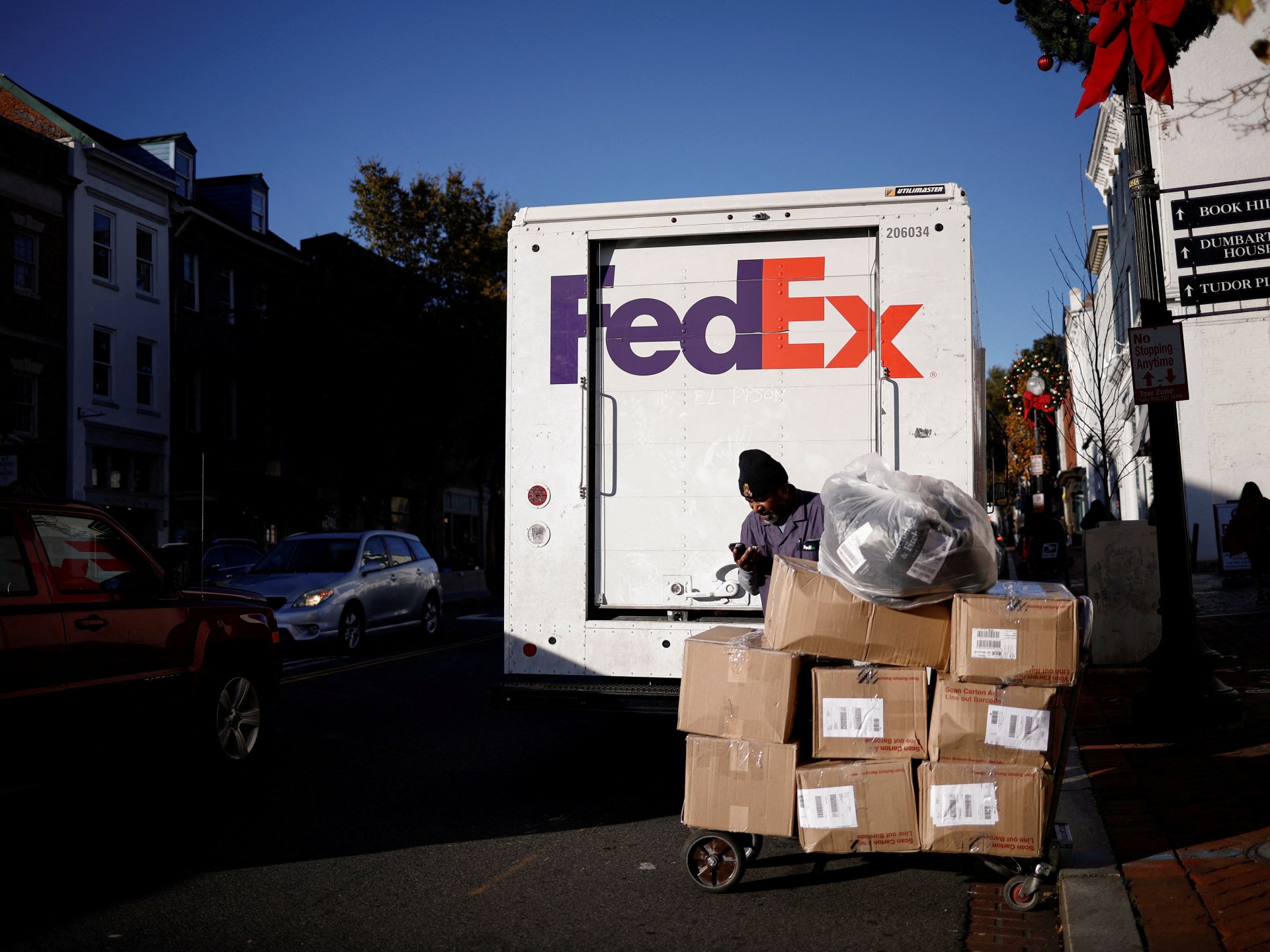

FedEx has sued the United States government to obtain a refund of money the logistics giant paid for tariffs imposed by President Donald Trump, just days after the US Supreme Court struck down the legal basis for the president’s scheme.
The Supreme Court ruled on Friday that Trump had overstepped his power and that only the US Congress had the authority to impose tariffs during peacetime.
- list 1 of 4Trump set to deliver second term’s first State of the Union: What to expect
- list 2 of 4Russia-Ukraine war: List of key events, day 1,461
- list 3 of 4Heavy rains, deadly floods hit southern Peru; thousands seek shelter
- list 4 of 4Australian PM backs removal of ex-Prince Andrew from succession line
end of list
FedEx filed the suit in the US Court of International Trade on Monday against Customs and Border Protection and its commissioner, Rodney Scott, who were tasked with collecting the tariffs imposed by Trump under the 1977 International Emergency Powers Act (IEEPA).
FedEx said in its legal complaint that the company had “suffered injury” from the tariffs and would seek a “full refund” from the US government following the Supreme Court ruling.
The company said in September that it expected to sustain a $1bn hit in 2026 from the tariffs as well as a related decision to end tariff exemptions on small packages valued under $800, according to the Reuters news agency.
Despite the court’s landmark ruling, there is still much uncertainty for FedEx and other global retailers, logistics companies, and US consumers.
The Supreme Court ruling did not offer guidance on whether the government should refund the billions of dollars in tariffs collected over the past year under IEEPA or how a refund process should proceed.
Experts have said that it could take months, if not years, to untangle the web of tariffs and sort out refunds. Trump has separately promised to impose a 15 percent “global tariff” to replace the IEEPA tariffs.
Advertisement
FedEx said in a statement that it had “taken necessary action to protect the company’s rights as an importer of record to seek duty refunds from US Customs and Border Protection”, although “no refund process has been established by regulators or the courts”.
The Chamber of Commerce and the National Retail Federation are among the industry groups pushing for a swift refund process.
Reuters reported that discount retailer Costco, cosmetics brand Revlon, and eyewear company EssilorLuxottica are also seeking tariff refunds.
Trump turned global trade upside down last year when he launched a trade war against Canada, Mexico and China, before expanding it to include most US trade partners, including countries with pre-existing free-trade agreements.
The Yale Budget Lab estimated that the US collected $142bn in tariffs under the IEEPA as of mid-December 2025. Other estimates have put the figure closer to $175bn.
While the IEEPA tariffs have been struck down, others remain in place, such as sector-specific tariffs imposed under Section 232 of the Trade Expansion Act of 1962, or Section 301 of the Trade Act of 1974.
The Yale Budget Lab said consumers will now face an average tariff rate of 9.1 percent. The figure is less than the 16.9 percent average rate under the IEEPA, but the highest since the end of World War II.
Related News
Iran-US tensions: What would blocking Strait of Hormuz mean for oil, LNG?
Why was former Prince Andrew arrested by UK police?

At least 11 Palestinians killed in Israeli attacks across Gaza