In Ukraine, deaths from hypothermia rise as Russia attacks energy system
 10 February 2026

Kyiv, Ukraine – No one was hurt when the first Russian drone hit Taira Sluisarenko’s apartment building in eastern Kyiv on the night after her 16th birthday.
“I was sitting on the bathroom floor and right away felt [the explosion] shook us more than usual,” shattering windows and outer walls of apartments several storeys above hers, she told Al Jazeera about the January 9 attack.
- list 1 of 4The Take: How the US left Ukraine exposed to Russia’s winter war
- list 2 of 4Ukraine pulls plug on Russian Starlink, beefs up drone defence
- list 3 of 4US has given Ukraine and Russia June deadline to end war: Zelenskyy
- list 4 of 4Child among 4 killed in latest Russian missile and drone barrage: Ukraine
end of list
“I began reconsidering my decision not to move to Poland,” where her aunt, cousin and sister live, she said. “But I felt no fear.”
Russian forces used a double-tap tactic of sending a second drone to the same location. Thirty minutes later, a blast outside the building killed Serhiy Smolyak, a 56-year-old emergency medic, and wounded his colleagues.
Russia launched 242 drones and 36 missiles that night, including an Oreshnik ballistic missile that Russian President Vladimir Putin calls “meteor-like”. It flies at 13,000 kilometres per hour (8,077 miles per hour) and cannot be intercepted by advanced Western air defence systems.
The assault killed four people and wounded dozens overall and destroyed energy infrastructure.
Dozens of similar attacks since 2022 have deprived millions of people throughout Ukraine of heat, power and running water as winter temperatures have dropped far below minus 10 degrees Celsius (14 degrees Fahrenheit), covering roads and the Dnipro, Europe’s fifth largest river, with thick ice.

Sluisarenko’s apartment building is new and advanced with insulated walls and solar panels that help power water pumping in the central heating system.
Advertisement
Its residents are affluent enough to pitch in for a huge, gas-guzzling generator that keeps the elevators running.
But all of that still was not enough to keep the apartments warm, and since the attack, Sluisarenko has been sleeping under two warm blankets with tights and four pairs of socks on.
Yet, she’s surviving.
‘White deaths’
At least 10 “white deaths” from hypothermia have been reported by emergency and health officials this year in two Ukrainian regions – Ternopil and Rivne, where infrastructure is far less damaged than in Kyiv or eastern and southern regions that are closer to Russia.
The pre-war population of Ternopil and Rivne was 2.1 million, or about 5 percent of Ukraine’s pre-war population of 42 million.
There are no overall statistics of “white deaths” for all of Ukraine because officials summarise such deaths only after the winter.
But a rough extrapolation – considering that about 6 million people have fled Ukraine since 2022 and almost 6 million live in Russia-occupied regions – suggests that the number of “white deaths” may be close to 200.
Descriptions of “white deaths” are gruesome with no names and few details.
A 41-year-old man died of “general hypothermia of the body” on Sunday in the town of Ostroh in Rivne, said the State Emergency Service of Ukraine.
It and the Ministry of Health did not immediately respond to Al Jazeera’s requests for comment.
A United Nations official warned that children are especially vulnerable to the cold, as has been seen in Gaza.
“Newborns and infants lose body heat rapidly and are at heightened risk of hypothermia and respiratory illness, conditions that can quickly become life-threatening without adequate warmth and medical care,” Munir Mammadzade, UNICEF country representative in Ukraine, said in a statement on January 16.
Russia’s campaign to freeze Ukraine into submission has intensified this winter, triggering many more health problems.
At least 18 deaths from carbon monoxide caused by indoor burning of wood and coal have been recently reported along with hundreds of cases of frostbite and thousands of instances of pneumonia and acute colds.
Cardiovascular diseases have skyrocketed along with worsening mental health as millions lie awake at night in frozen apartments hearing the buzzing of drones, whooshing of missiles and heavy thuds of air defences above them.
‘We do everything to keep people warm’
The struggle for warmth is a 24/7 ordeal.
“Without power, we’re like in a coffin,” Yelena Hodarenko, who struggles to survive in the northern Kyiv district of Troeshchina, told Al Jazeera as she showed a thin crust of ice on her kitchen floor next to the outer wall.
Advertisement
Her 12-storey apartment building has had no central heating since mid-January after ice burst the pipes. The power supply resumes for one to two hours a day, always unexpectedly, and after getting stuck in the elevator three times, Hodarenko prefers to take the stairs to her apartment on the eighth floor.
She fumbles her way in icy darkness past graffiti-covered concrete walls with a faint cellphone torchlight, greeting neighbours scurrying up and down the stairs.

Her biggest worry is her pallid-faced husband, Mikyailo, bedridden after three surgeries. Every time the power is back on, she rushes to heat up water and pour it in plastic bottles that keep his feet warm under five blankets.
Her neighbourhood looks postapocalyptically deserted after many residents left for their relatives’ and friends’ countryside houses that rely on firewood and coal for warmth.
They followed the call of Kyiv’s mayor.
On January 22, Vitali Klitschko said 600,000 people had already left the city of 3 million and urged others who have “options” to stay in the countryside to leave too.
“I’m telling you honestly, the situation is complicated and now may not be the most complicated time,” he said at the time.
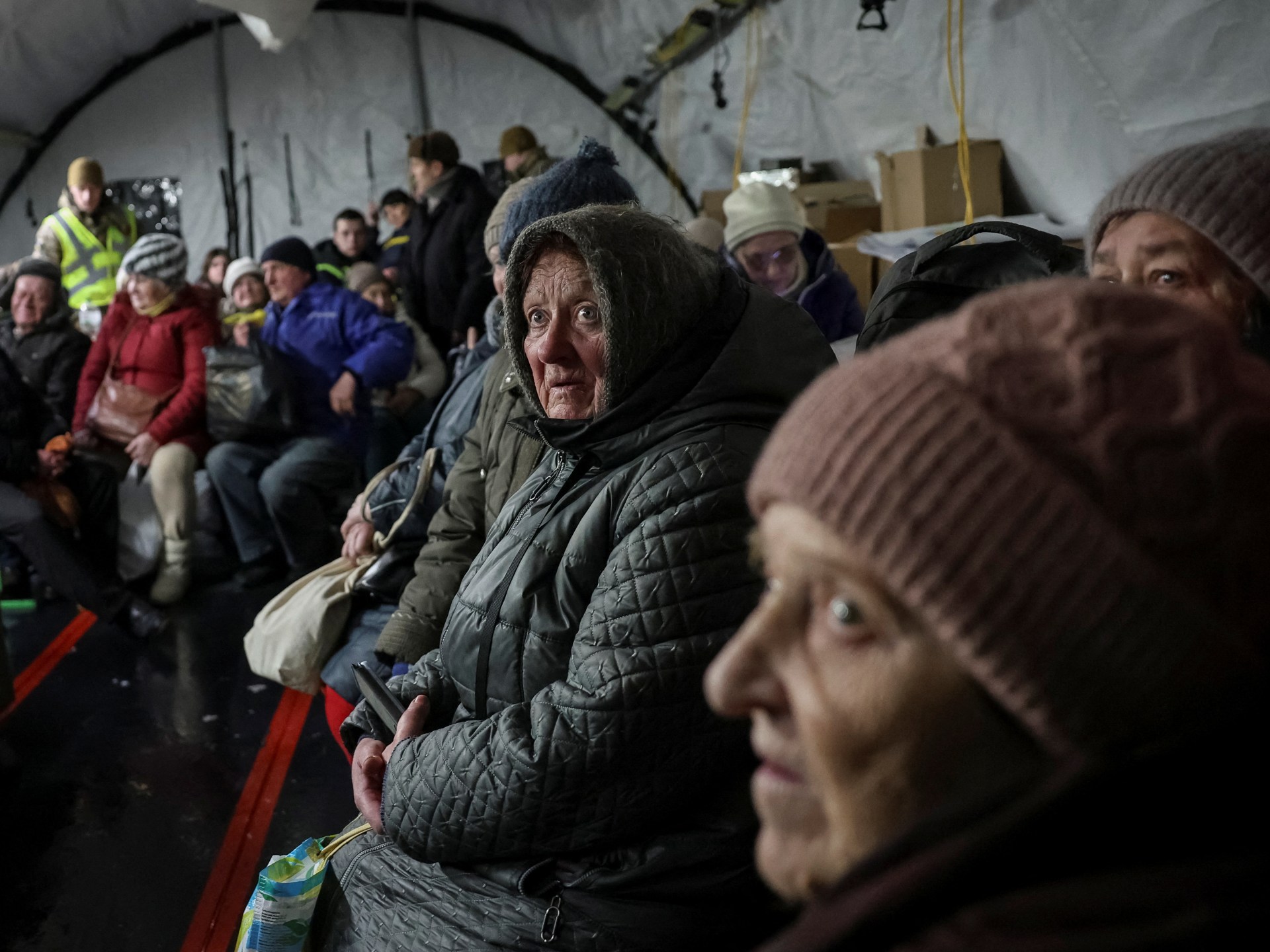
Some military units have sent their medics and rescue teams to pitch army tents with simple wood stoves where dozens of civilians sleep on bunk beds.
“We do everything to keep people warm,” Tymofei, a military medic with the 2nd Special Medical Battalion told Al Jazeera, withholding his last name in accordance with wartime regulations.
His colleagues were warming up a giant cauldron of plov, a hearty Central Asian dish of rice, meat and carrots, to be distributed free of charge.
Related News

New Yemen government formed with Shaya Mohsin al-Zindani as prime minister
At least 53 people dead or missing after boat capsizes off Libya coast
Israel kills 12 Palestinians in Gaza as Rafah crossing set to open