

Islamabad, Pakistan – When US President Donald Trump’s financial earnings in 2025 were released this week, one figure stood out. His family’s crypto venture, World Liberty Financial (WLF), brought him more than $500m from token sales alone last year, part of a broader crypto windfall worth hundreds of millions of dollars more.
Pakistan was among the first countries to sign up with the firm.
- list 1 of 4‘Clear message’: Pakistan hires Binance boss in crypto push
- list 2 of 4‘Strategic handshake’: How Pakistan is wooing Trump with critical minerals
- list 3 of 4What does Pakistan stand to gain from helping broker the US-Iran deal?
- list 4 of 4How Pakistan’s Asim Munir became Trump’s ‘favourite field marshal’
end of list
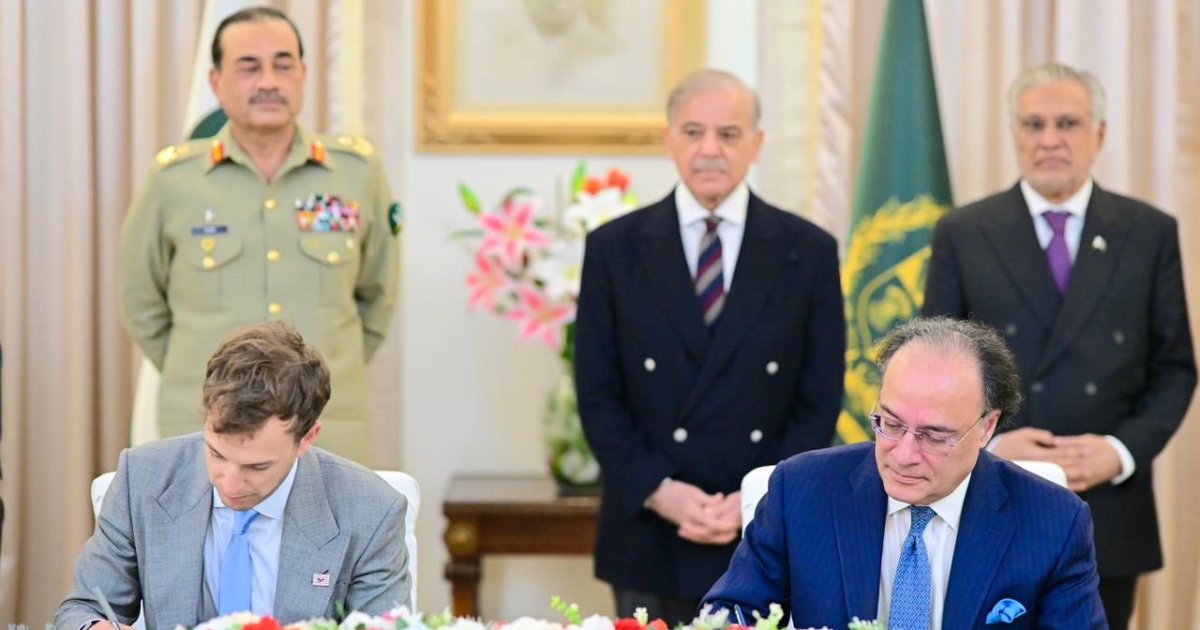
In January, Pakistan’s Ministry of Finance signed a memorandum of understanding with SC Financial Technologies, an affiliate of World Liberty Financial, to explore the use of its dollar-pegged USD1 stablecoin for cross-border payments.
Prime Minister Shehbaz Sharif and army chief Field Marshal Asim Munir were both present as the firm’s executives, including Trump adviser Steve Witkoff’s son Zach, were welcomed to Islamabad. Witkoff Jr signed the agreement with Pakistan’s Finance Minister Muhammad Aurangzeb.
Nearly six months later, Pakistani officials have confirmed that there has been no pilot project to use USD1, no licences issued and no known transactions using the stablecoin.
Yet, despite the gap between the ceremony and the official aim of the MoU, analysts say Pakistan has achieved something no less valuable than the half-a-billion dollars earned by Trump from World Liberty Financial: it has given Islamabad rare access to the Trump administration.
Questions over utility
A stablecoin is a digital currency pegged to a fixed value, almost always the US dollar, designed to move money over the internet without banks. USD1 is World Liberty Financial’s version.
Advertisement
The firm earns interest on the reserves backing each coin, meaning wider use of USD1 generates income for its owners, including the Trump family.
Pakistan is already one of the world’s largest crypto markets. According to the Chainalysis crypto adoption index, the country ranked third globally last year, behind India and the United States, with much of the informal crypto activity believed to flow through Tether’s USDT, the world’s largest stablecoin.
There are no indications that USD1 featured in any Pakistani transactions. More broadly, how much money moves through such channels remains unclear.
A senior banking executive in Pakistan, speaking on condition of anonymity, said no reliable estimate exists and that figures in circulation are inferred from formal inflows rather than directly measured.
Informal channels are thought to account for roughly a 10th of remittances, with stablecoins forming an unquantified portion of that amount.
That uncertainty comes against a backdrop of record formal inflows. Pakistan received $38.3bn in remittances in the last financial year, its highest-ever total and a 27 percent increase over the previous year, according to the State Bank of Pakistan, the country’s central bank.
In May, the latest month for which data is available, inflows reached a record $4.25bn. The central bank expects remittances to cross $42bn this year.
That raises a broader question over the rationale for the deal itself.
“Why are people using USDT [the Tether stablecoin] in the first place, considering Pakistan is receiving record remittances through the banking channel, and transfers now happen instantaneously in many cases?” Ibrahim Khalil, a Canada-based banking and finance professional, told Al Jazeera. “Whatever the reason, [these] people are avoiding the banking channel. USD1 will not solve that issue if banking channels are involved.”
Khalil also pointed to a practical constraint.
Pakistan’s central bank held $16.5bn in reserves in late June, enough to cover roughly two months of imports.
Unless Pakistan’s trading partners accept USD1 directly, he said, the central bank would still need to convert the token back into dollars before it could be used, potentially adding friction rather than removing it.
Regulation before rollout
Pakistan has nevertheless moved quickly to establish a regulatory framework.
The Virtual Assets Act, passed in March, created a permanent regulator, the Pakistan Virtual Assets Regulatory Authority (PVARA), with powers to license firms and impose prison sentences of up to five years for operating without approval.
Advertisement
In April, the State Bank cleared banks to open accounts for licensed crypto firms.
But PVARA is still only accepting preliminary applications, with full licensing rules yet to be published. Binance and HTX, two global exchanges, have been granted no-objection certificates and are registered but are not yet authorised to operate.
The senior banking executive who spoke on condition of anonymity was cautious when discussing the World Liberty Financial agreement. “The MoU in question is exploratory, technical dialogue and knowledge-sharing, with no commitment to deploy any particular stablecoin,” he told Al Jazeera.
Any firm meeting PVARA’s licensing requirements could ultimately serve the same function, he added. “The architecture matters more than the counterparty.”
On timelines, he was blunt. Licensing, bank onboarding, a pilot and eventual scaling would realistically take months, he said.
Diplomacy and access
If the remittance case remains uncertain, the diplomatic logic behind the agreement is harder to dismiss.
The World Liberty Financial delegation first arrived in Islamabad in April last year, days after a deadly attack by armed fighters in Indian-administered Kashmir’s Pahalgam pushed India and Pakistan towards renewed tensions.
In June last year, Pakistan nominated Trump for the Nobel Peace Prize, crediting his “stellar statesmanship” for helping defuse the May standoff with India.
Trump also hosted Munir for lunch at the White House in June 2025, marking the first time a US president had received a Pakistani army chief who was not also head of state.
The January MoU came just before the US-Israeli war on Iran, during which Pakistan positioned itself as a mediator between Washington and Tehran.
Last month in Switzerland, US Vice President JD Vance credited Munir with helping broker a framework for peace between Washington and Tehran, calling him a great “statesman”.
Bilal Bin Saqib, who chairs PVARA, was named an adviser to World Liberty Financial in April last year — he left that role after he joined the Pakistani government. In March 2026, Bin Saqib told Bloomberg that the crypto push had opened doors and rebuilt trust with Washington.
The White House has said that there were no conflicts of interest.
Bin Saqib, PVARA and the Finance Ministry did not respond to requests for comment.
Whether the deal ultimately benefits Pakistani workers may, in the end, matter less than what it has already delivered for the state.
“The MoU was nothing more than an instrument of access. It had no real policy basis,” said Khurram Husain, a Karachi-based economist and commentator. “Access was the calculation, and it paid off spectacularly. The tangible gains for Islamabad were getting good access to the Trump White House, which was then added to by the diplomacy in the context of the Iran war.”
Khalil concurred.
“My bottom line would be that this whole exercise was pay for access,” he said.
Related News
Key moments from former Qatar Emir Sheikh Hamad bin Khalifa Al Thani’s life

Pro-Palestine football fans lament West Ham for signing Manor Solomon
Myanmar court sentences activists to 37 years over election protest